Pest Control Marketing Agency
What an agency actually does for a pest control company, and how to judge one.
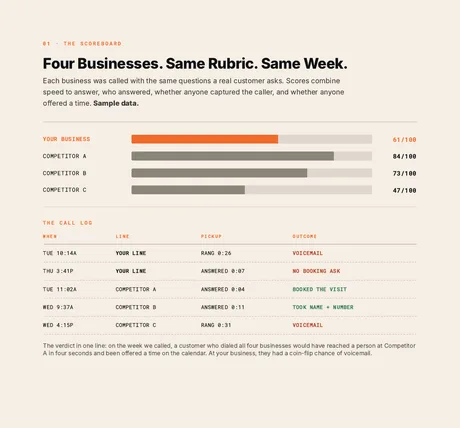 See a Sample Report (PDF)Six pages. Five recorded calls, one timed form fill, scored by AI against published standards.What it findsCalls ringing out to voicemailAnswered calls that never ask for the jobForm fills that wait hours for a humanThe competitor winning the first call
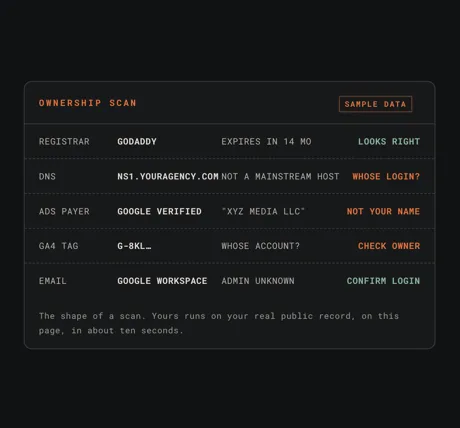 See What a Scan ReturnsPublic records read from the outside, in about ten seconds, with nothing to install.What it readsThe registrar, and when the domain expiresDNS, and whose nameservers those areThe business name paying for the adsThe GA4 tag and the email host
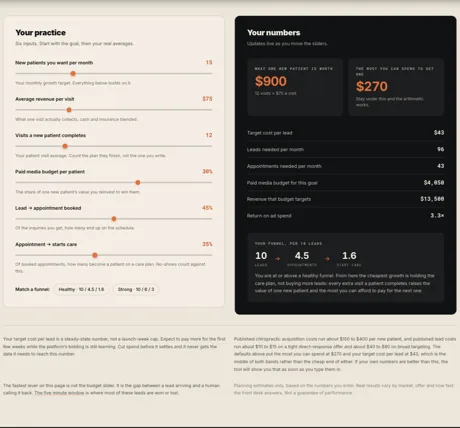 Run the NumbersSix sliders, figures that move as you drag them, and nothing you type leaves the page.What it works outWhat one new patient is worthThe most you can spend to win oneLeads and appointments you need a monthThe paid budget that hits the goal
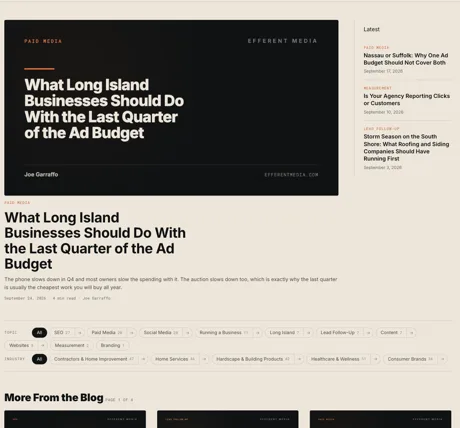 Read the LatestWritten off real Long Island accounts, the things we get wrong included.What it coversPaid media and budget decisionsSEO and the local map packLead follow-up and response timeRunning a Long Island business
See a Sample Report (PDF)Six pages. Five recorded calls, one timed form fill, scored by AI against published standards.What it findsCalls ringing out to voicemailAnswered calls that never ask for the jobForm fills that wait hours for a humanThe competitor winning the first call
See What a Scan ReturnsPublic records read from the outside, in about ten seconds, with nothing to install.What it readsThe registrar, and when the domain expiresDNS, and whose nameservers those areThe business name paying for the adsThe GA4 tag and the email host
Run the NumbersSix sliders, figures that move as you drag them, and nothing you type leaves the page.What it works outWhat one new patient is worthThe most you can spend to win oneLeads and appointments you need a monthThe paid budget that hits the goal
Read the LatestWritten off real Long Island accounts, the things we get wrong included.What it coversPaid media and budget decisionsSEO and the local map packLead follow-up and response timeRunning a Long Island business
Read the LatestWritten off real Long Island accounts, the things we get wrong included.What it coversPaid media and budget decisionsSEO and the local map packLead follow-up and response timeRunning a Long Island business
See a Sample Report (PDF)Six pages. Five recorded calls, one timed form fill, scored by AI against published standards.What it findsCalls ringing out to voicemailAnswered calls that never ask for the jobForm fills that wait hours for a humanThe competitor winning the first call
See What a Scan ReturnsPublic records read from the outside, in about ten seconds, with nothing to install.What it readsThe registrar, and when the domain expiresDNS, and whose nameservers those areThe business name paying for the adsThe GA4 tag and the email host
Run the NumbersSix sliders, figures that move as you drag them, and nothing you type leaves the page.What it works outWhat one new patient is worthThe most you can spend to win oneLeads and appointments you need a monthThe paid budget that hits the goal
Read the LatestWritten off real Long Island accounts, the things we get wrong included.What it coversPaid media and budget decisionsSEO and the local map packLead follow-up and response timeRunning a Long Island business
Long Island · Pest Control
Four pest control companies on this island already hired us, and one of them has been treating Nassau and Suffolk homes since 1947.

What marketing works for a pest control company?
Being findable in the town the customer is standing in, and then being priced as though the lead is worth a route rather than a single visit. A pest problem is urgent enough to act on tonight and tolerable enough to sleep on, so the buyer does a handful of searches in one sitting and calls two companies the next morning. Organic search and the map pack decide who those two are, town by town. The recurring plan is what decides whether the lead was profitable.
One of them has been treating Nassau and Suffolk homes since 1947. Another runs multi-state. The playbook is not the same for both, and neither is the reporting.
 Arrow Exterminating
 East End Tick Control
 Twin Forks Pest Control
 Fox Pest Control
Of all the transitions I have had in my nearly 3 years, you and Joe have by far been the most professional and helpful, and for that I’m sincerely grateful.
“I know to you that is how you operate, but to many others, they don’t have that ethic.”
Beth LowellAcquisition Marketing Manager · Rentokil, Arrow Exterminating’s parentWhere the money actually is
Almost every pest control account we have looked at runs one campaign against every service line and reports one cost per lead. That average puts a $180 rodent callout and a $900 annual plan in the same number, and it hides both: the callout looks expensive and the plan looks like a bargain nobody chased.
The first treatment is an ad cost. Recurring service is the asset.
A lead worth four visits a year is not priced like a one-off callout.
Nassau and Suffolk are not one service area and neither is the East End.
Split them and the bidding changes, because the second one is worth several visits a year for as long as the customer stays. That is the difference between buying jobs and building a route.
By service line
Most pest control marketing runs one campaign against all of them and reports one cost per lead, which averages a $180 callout against a $900 annual plan and hides both.
The first treatment barely covers acquisition. The plan is where the money is, and almost no account is bid as though the lead were worth four visits a year.

A wood-destroying insect report sits inside a closing, so the search happens under a deadline and the winner is whoever can be there this week. Realtor and attorney referral traffic behaves nothing like a homeowner search.

Demand arrives with the first warm weekend and it does not wait for a media plan. Position bought in March costs a fraction of position bought in June.

This is the closest thing to emergency demand the category has. It is decided in an evening by whoever answers first the next morning, and an unanswered 9pm form is somebody else’s customer by breakfast.

Restaurants, food service, property managers and municipalities buy on compliance, documentation and a name they can defend to an inspector. The sales cycle is long and the search terms are nothing like the residential set.

Garden City and Riverhead are not one market. A service-area page built on a radius loses to a competitor with a real page for the town, and the map pack has to be tracked that way to know it.
How we run it
Five moves, and the first two are not paid media.
01 / 05
01
This is what moved Arrow. The site had a blog that was selling against a pest library already doing the informing. Rebuilt off search data and written to how people actually ask, including out loud.
The cheapest channel this category has
02
A service-area page built on a radius loses to a competitor with a real page for the town. Coverage is built and tracked one town at a time, across Nassau, Suffolk and the East End.
03
Termite inspections sit inside a closing. Tick and mosquito open on a weather report. Rodent is the closest thing to an emergency. One campaign against all three reports an average that describes none of them.
04
The searching happens after dinner and the calling happens the next morning. An unacknowledged 9pm form is somebody else's customer by breakfast.
Missed call text-back, every hour
05
Renewals, seasonal reminders and the lapsed route. The list is already in the CRM and nobody works it, because it is tedious and it is nobody's actual job.
What four years of organic did
Arrow is a pest control company founded in 1947 that had a blog nobody outside the company had a reason to read. These are the figures we publish about that work, and they are organic search and content rather than paid.
Volume, outcomes, and the rate underneath them
ARROW · PUBLISHEDCoverage, town by town
DIAGRAMNassau County
Suffolk County
What matters here
FAQ
Straight answers. If something is not here, ask us on the audit call.
Yes, and four of them have hired us: Arrow Exterminating, East End Tick Control, Twin Forks Pest Control and Fox Pest Control. Arrow has been treating Nassau and Suffolk homes since 1947.
The map pack in the towns you actually service, and a phone or form that gets answered in the evening. Most of this category's searching happens after dinner and most of its calling happens the next morning.
By what the customer is worth on a route, not by the first treatment. A recurring plan is several visits a year for as long as they stay, and an account bid at first-visit revenue underpays for the leads that become plans.
Because they are different buyers on different clocks. A wood-destroying insect report sits inside a real estate closing with a deadline. Tick and mosquito demand opens on the first warm weekend. One campaign against both reports an average that describes neither.
Before it starts. Position bought in March costs a fraction of position bought in June, and going dark in the off season costs you ground that has to be re-bought.
Yes, and it is organic rather than paid. Arrow Exterminating's site users went from 10,616 to 166,828 over four years, with goal conversions up 519% year over year. The full write-up is at /case-studies/arrow/.
An inbound call over sixty seconds that a human answered. A completed call that rang out to voicemail is not a lead, and counting it as one corrupts every decision after it.

Let’s talk
Tell us about your business. We’ll show you where the growth is, within 48 hours.
Other industries
What an agency actually does for a pest control company, and how to judge one.
Paid search and paid social for a business with a season and a route.
Where social earns a pest control company money, and where it does not.
Roofing, siding, hardscape, remodeling. Including James Hardie contractors.
HVAC, heating oil, pest control, plumbing and the companies Long Island calls when something breaks.
Manufacturers and the dealer networks that sell for them.
Chiropractic, wellness and specialty practices that need patients, not just clicks.
Retail and direct to consumer, built on the same fundamentals as a local launch.
From the Blog
Platforms came and went and most of the advice aged badly. Four things actually changed, and the list of what did not is shorter and more useful than any trend piece.
The same handful of findings show up in nearly every account we inherit. Here they are in order, so you can fix them yourself without hiring anyone.
Quotes that went quiet, last season's estimates, the week you were slammed. That list is the cheapest pipeline you own, and working it does not require hiring anybody.