Strategy & Advisory
A senior strategist looking at the whole business, not just one campaign.
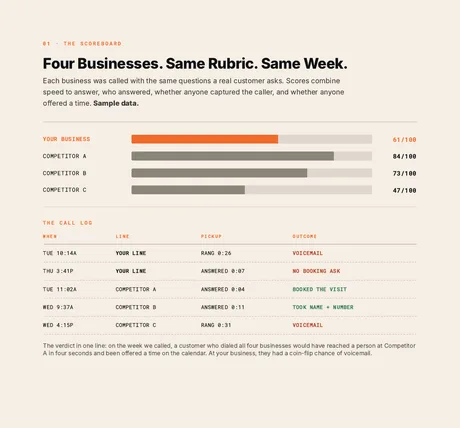 See a Sample Report (PDF)Six pages. Five recorded calls, one timed form fill, scored by AI against published standards.What it findsCalls ringing out to voicemailAnswered calls that never ask for the jobForm fills that wait hours for a humanThe competitor winning the first call
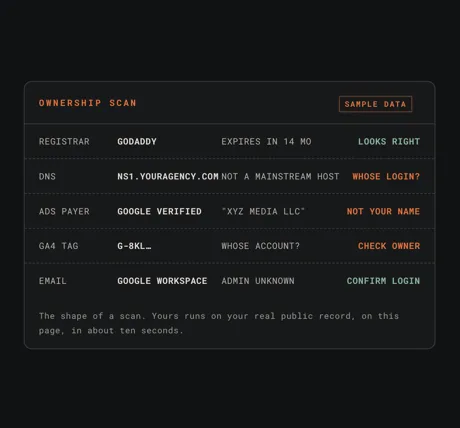 See What a Scan ReturnsPublic records read from the outside, in about ten seconds, with nothing to install.What it readsThe registrar, and when the domain expiresDNS, and whose nameservers those areThe business name paying for the adsThe GA4 tag and the email host
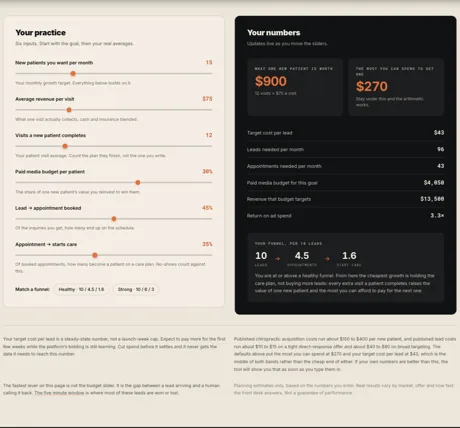 Run the NumbersSix sliders, figures that move as you drag them, and nothing you type leaves the page.What it works outWhat one new patient is worthThe most you can spend to win oneLeads and appointments you need a monthThe paid budget that hits the goal
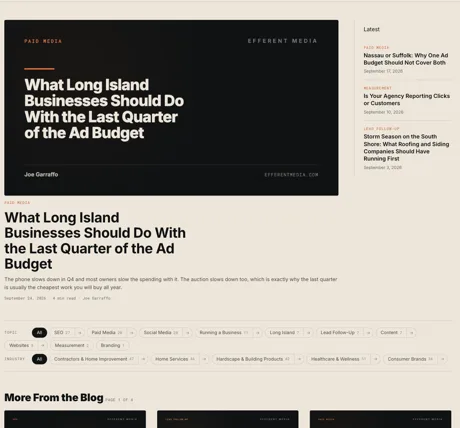 Read the LatestWritten off real Long Island accounts, the things we get wrong included.What it coversPaid media and budget decisionsSEO and the local map packLead follow-up and response timeRunning a Long Island business
See a Sample Report (PDF)Six pages. Five recorded calls, one timed form fill, scored by AI against published standards.What it findsCalls ringing out to voicemailAnswered calls that never ask for the jobForm fills that wait hours for a humanThe competitor winning the first call
See What a Scan ReturnsPublic records read from the outside, in about ten seconds, with nothing to install.What it readsThe registrar, and when the domain expiresDNS, and whose nameservers those areThe business name paying for the adsThe GA4 tag and the email host
Run the NumbersSix sliders, figures that move as you drag them, and nothing you type leaves the page.What it works outWhat one new patient is worthThe most you can spend to win oneLeads and appointments you need a monthThe paid budget that hits the goal
Read the LatestWritten off real Long Island accounts, the things we get wrong included.What it coversPaid media and budget decisionsSEO and the local map packLead follow-up and response timeRunning a Long Island business
Read the LatestWritten off real Long Island accounts, the things we get wrong included.What it coversPaid media and budget decisionsSEO and the local map packLead follow-up and response timeRunning a Long Island business
See a Sample Report (PDF)Six pages. Five recorded calls, one timed form fill, scored by AI against published standards.What it findsCalls ringing out to voicemailAnswered calls that never ask for the jobForm fills that wait hours for a humanThe competitor winning the first call
See What a Scan ReturnsPublic records read from the outside, in about ten seconds, with nothing to install.What it readsThe registrar, and when the domain expiresDNS, and whose nameservers those areThe business name paying for the adsThe GA4 tag and the email host
Run the NumbersSix sliders, figures that move as you drag them, and nothing you type leaves the page.What it works outWhat one new patient is worthThe most you can spend to win oneLeads and appointments you need a monthThe paid budget that hits the goal
Read the LatestWritten off real Long Island accounts, the things we get wrong included.What it coversPaid media and budget decisionsSEO and the local map packLead follow-up and response timeRunning a Long Island business
Service
Meta, TikTok, Nextdoor and Pinterest, run as one channel for businesses where the buying decision is expensive and considered.
Leads, full year
1,771On roughly $77,000 of paid socialBlended cost per lead
$44Across a full year, all four campaign layersClick-through rate
2.0%Against a 1% category benchmarkLanding page conversion
8.0%Against a 5.2% home improvement averageHow is paid social different from paid search?
Search catches demand that already exists. Nobody on Instagram woke up looking for a new roof, so paid social has to create the demand and then catch it, which takes creative that earns attention and an offer worth acting on. The surface is Meta, TikTok, Nextdoor and Pinterest, plus LinkedIn where the work is commercial, and it is measured the same way search is: calls, leads and booked jobs, read from the CRM rather than from the platform's own self-reported attribution.
What it produced
A cost per click can always be driven down by buying worse traffic, and most accounts reporting a falling CPC are doing exactly that. These two are the opposite trade.
Source: Good Guys Contracting, published at /case-studies/good-guys/. These are the account’s paid social figures specifically: 1,771 leads on roughly $77,000 of paid social across a full year.
Source: Sky Organics, published at /case-studies/sky-organics/. Each figure is measured against the best rate the account had achieved before us, not against its average.
How it is built
A person who watched thirty seconds of a video and a person who came to the site and did not call are worth different money and should not see the same ad. Most accounts run them as one audience.
Source: Good Guys Contracting, published at /case-studies/good-guys/. These are the account’s paid social figures specifically: 1,771 leads on roughly $77,000 of paid social across a full year.
Meta carries most of this money. TikTok, Nextdoor and Pinterest earn a place when the category and the creative justify it, and we will tell you when one does not.
What you actually see
Journey is our own portal, and it reads from your CRM rather than from Meta’s self-reported attribution. When the two disagree, the gap is information rather than an argument.
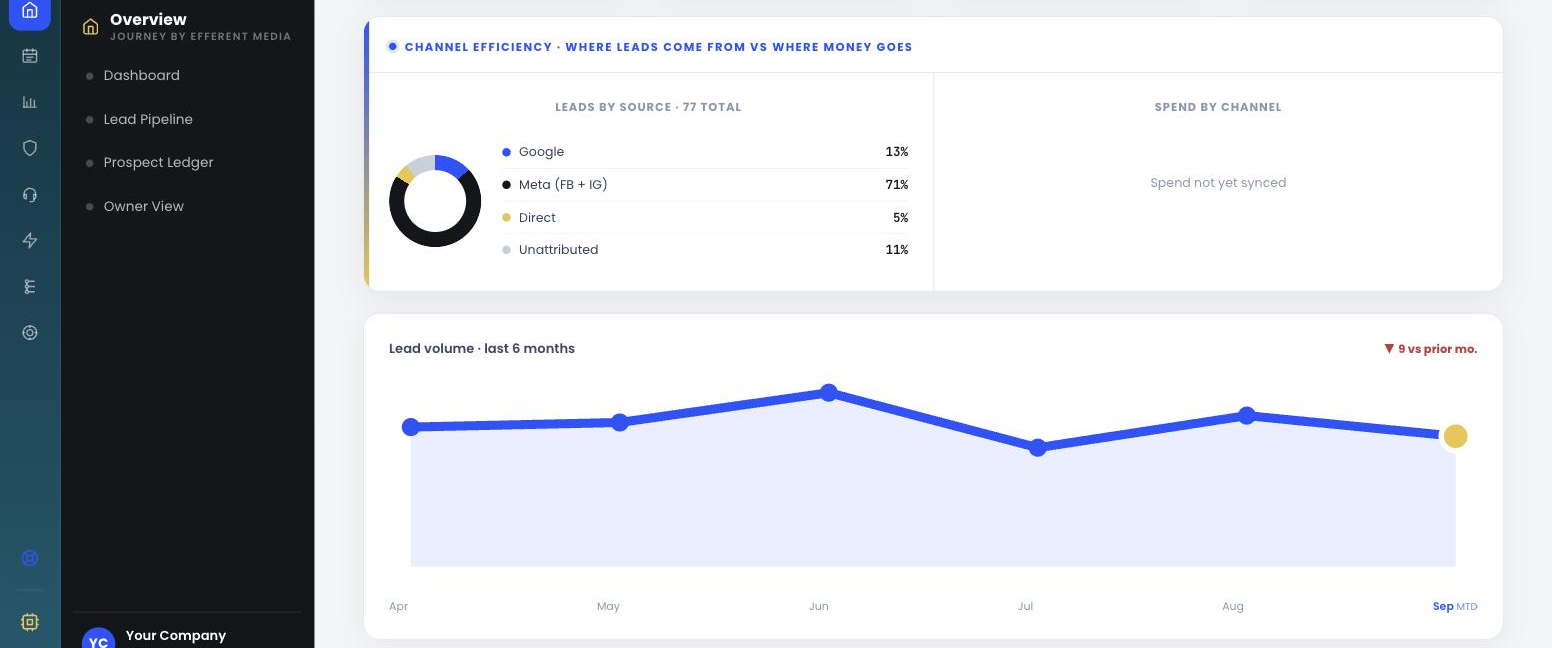
Journey is our own client portal. Every client gets a login on day one, and every figure on it traces to their own records rather than to a platform dashboard. Captured from a live client view with the account name, the login email and the client’s own domain replaced before the screenshot was taken.
How we run it
Four things, and the first two decide almost everything.
01 / 05
01
Shot on the job, not repurposed from a brochure. The most effective ads in this category look like something a person filmed, because they were.
02
A free inspection, a seasonal window, a financing term. Tested against each other rather than assumed.
Offers are tested, not debated
03
Geography, homeownership and the handful of signals that predict a buyer. Layering ten interests on top narrows the auction and raises the price for no gain.
04
You are advertising to a market of a few hundred thousand households, not a country. Burning the same creative into it is how a brand gets actively disliked.
05
Platform-reported conversions are an estimate the seller produced. We reconcile against booked jobs.
The platform is not a neutral scorekeeper
What we measure
What gets reported against what decides anything
INTERFACE| What gets reported | What decides anything |
|---|---|
| Impressions | Qualified calls |
| Clicks | Forms with a real problem in them |
| Click-through rate | Cost per qualified lead |
| Keyword rankings | Booked jobs |
| Sessions | Revenue you can trace back |
The most effective ads in this category look like something a person filmed, because they were.What the creative actually is
Shot on the job, not repurposed from a brochure. More of it than you think and less polished than you fear, tested against each other rather than debated in a meeting.

Scope
Where it earns its place
If people are already searching for what you do and you are not capturing all of it, paid social is the more expensive way to get the same customer. Capture first.
Once search is saturated, paid social is the cheapest way to grow the size of the market you are fishing in, and it makes every search campaign underneath it cheaper by lifting branded demand.
| What gets reported | What decides anything |
|---|---|
| Impressions | Qualified calls |
| Clicks | Forms with a real problem in them |
| Click-through rate | Cost per qualified lead |
| Keyword rankings | Booked jobs |
| Sessions | Revenue you can trace back |
Drawn, not captured. Reach and engagement are diagnostics, not results.
More services
A senior strategist looking at the whole business, not just one campaign.
Google and Meta ads built to generate calls and booked jobs, not impressions.
Show up when Long Island customers search for what you do.
Own the map pack in the towns you actually serve.
From the Blog
LinkedIn, known for its professional and business-oriented users, provides a unique opportunity for businesses and brands to target a niche audience. As with any platform, however, success on LinkedIn requires a hyper-focused strategy tailored to a specific audience. Here are five key tips for.
Having a presence on the most popular and effective social media platforms has become crucial for companies to promote their products and services and connect with their customers. With an overwhelming number of choices available today, you may be asking yourself, “which social media platforms do I.
As many social media advertisers know, finding the most successful combinations of creative and messaging is essential to running an optimal Facebook campaign. Questions you might ask yourself include: which ad creative size will bring in the most video views? What headline will help increase.
FAQ
Straight answers. If something is not here, ask us on the audit call.
Yes, as a demand generation layer once search is saturated, and very well for seasonal offers and financing. It is not a replacement for search.
More than you think and less polished than you fear. Real footage from real jobs outperforms produced spots in this category, consistently.
No. Boosting optimizes for engagement, which is not a customer. The same money in a properly structured campaign buys outcomes instead of applause.
Meta carries most of this money in this book, and Facebook and Instagram are one buy rather than two. TikTok where the category and the creative justify it, and the creative has to be real footage rather than a produced spot. Nextdoor for neighborhood-level trust, which is the closest thing online to a referral. Pinterest for kitchens, baths, hardscape and exteriors, where people save ideas months before they buy. LinkedIn for commercial work and recruitment. We will tell you when a platform is not worth your money rather than adding it to look thorough.
Often, and for a different reason than the others. The audience is small and it is your actual service area, and a recommendation there carries more weight than an ad anywhere else. It will not scale like Meta. It is not supposed to.
For anything visual with a long consideration window, yes. Kitchens, baths, hardscape, siding and exteriors are saved to boards months before anyone calls, which makes it a demand-building surface rather than a lead-today one. We do not put a roof repair emergency budget there.
Because the platform is reporting its own contribution using its own model. We reconcile against booked jobs and treat the gap as information rather than as an argument.
It can be, and it needs care. Health-related targeting and data sharing are restricted, and the right answer is to send less, never to relabel what you send. We screen this before anything runs.

Let’s talk
Tell us about your business. We’ll show you where the growth is, within 48 hours.