Search Captures
Paid search, SEO and the map pack harvest the demand that exists today. They get funded first, and they are also where the streaming effect shows up: more branded queries, cheaper branded clicks, better visitors.
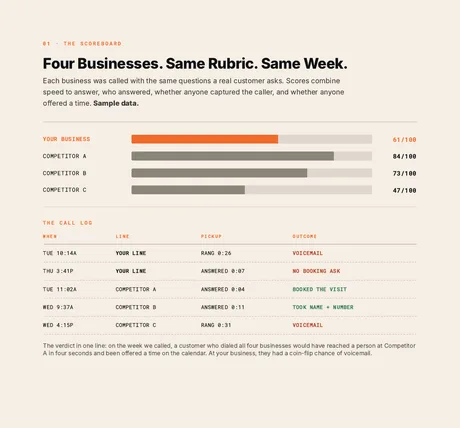 See a Sample Report (PDF)Six pages. Five recorded calls, one timed form fill, scored by AI against published standards.What it findsCalls ringing out to voicemailAnswered calls that never ask for the jobForm fills that wait hours for a humanThe competitor winning the first call
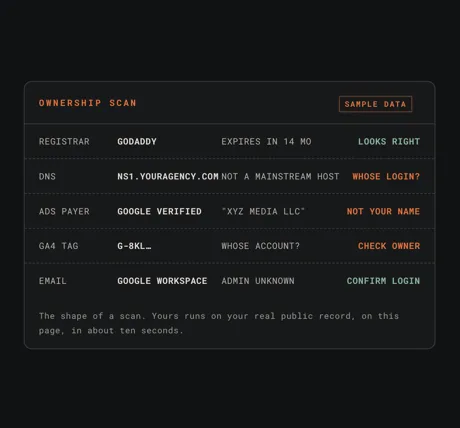 See What a Scan ReturnsPublic records read from the outside, in about ten seconds, with nothing to install.What it readsThe registrar, and when the domain expiresDNS, and whose nameservers those areThe business name paying for the adsThe GA4 tag and the email host
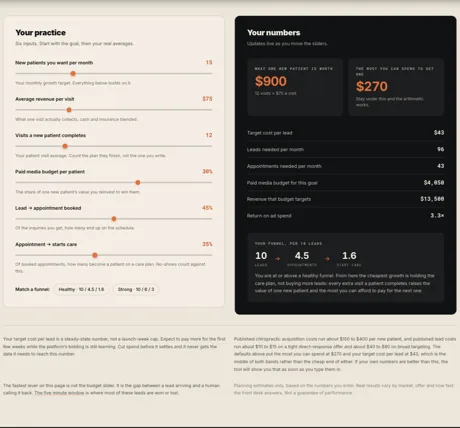 Run the NumbersSix sliders, figures that move as you drag them, and nothing you type leaves the page.What it works outWhat one new patient is worthThe most you can spend to win oneLeads and appointments you need a monthThe paid budget that hits the goal
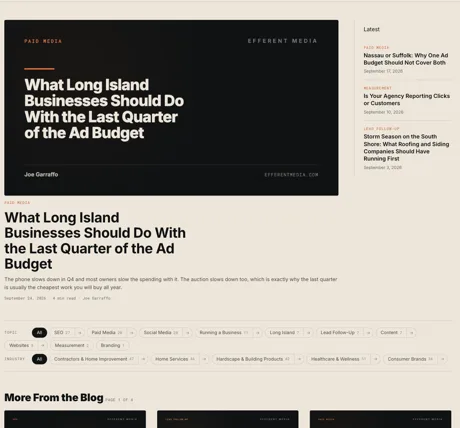 Read the LatestWritten off real Long Island accounts, the things we get wrong included.What it coversPaid media and budget decisionsSEO and the local map packLead follow-up and response timeRunning a Long Island business
See a Sample Report (PDF)Six pages. Five recorded calls, one timed form fill, scored by AI against published standards.What it findsCalls ringing out to voicemailAnswered calls that never ask for the jobForm fills that wait hours for a humanThe competitor winning the first call
See What a Scan ReturnsPublic records read from the outside, in about ten seconds, with nothing to install.What it readsThe registrar, and when the domain expiresDNS, and whose nameservers those areThe business name paying for the adsThe GA4 tag and the email host
Run the NumbersSix sliders, figures that move as you drag them, and nothing you type leaves the page.What it works outWhat one new patient is worthThe most you can spend to win oneLeads and appointments you need a monthThe paid budget that hits the goal
Read the LatestWritten off real Long Island accounts, the things we get wrong included.What it coversPaid media and budget decisionsSEO and the local map packLead follow-up and response timeRunning a Long Island business
Read the LatestWritten off real Long Island accounts, the things we get wrong included.What it coversPaid media and budget decisionsSEO and the local map packLead follow-up and response timeRunning a Long Island business
See a Sample Report (PDF)Six pages. Five recorded calls, one timed form fill, scored by AI against published standards.What it findsCalls ringing out to voicemailAnswered calls that never ask for the jobForm fills that wait hours for a humanThe competitor winning the first call
See What a Scan ReturnsPublic records read from the outside, in about ten seconds, with nothing to install.What it readsThe registrar, and when the domain expiresDNS, and whose nameservers those areThe business name paying for the adsThe GA4 tag and the email host
Run the NumbersSix sliders, figures that move as you drag them, and nothing you type leaves the page.What it works outWhat one new patient is worthThe most you can spend to win oneLeads and appointments you need a monthThe paid budget that hits the goal
Read the LatestWritten off real Long Island accounts, the things we get wrong included.What it coversPaid media and budget decisionsSEO and the local map packLead follow-up and response timeRunning a Long Island business
Service
Your business inside the shows Nassau and Suffolk households actually stream, bought by zip code, and judged the way television should be judged for a local company.
Bought by
Zip codeThe towns your trucks reach, never a national audience you cannot serviceJudged on
CallsBranded search, calls and booked jobs. Never impressions servedFrequency
CappedPer household, so the same living room is not hit fifteen times in a weekAccounts and data
YoursYour ad accounts and every row of your data, in writingDoes connected TV advertising work for a local business?
It can, and only in a specific situation: when you are already capturing the demand that exists and want to grow the size of it. Streaming and programmatic put you in front of households before anyone starts searching, targeted down to your service area. Done properly it lifts branded search, direct calls and close rate on everything downstream. Bought before the capture side works, it is a donation.
Plain terms
Connected TV is advertising that runs inside streaming television: the ad-supported tiers of Hulu, Peacock and Paramount+, the free channels built into a smart television, and the networks’ own apps. Your spot plays on the largest screen in the house, in full sight and sound, to a household you picked by geography and demographics. OTT is the same delivery on any screen; programmatic is how the placement gets bought, in real time across thousands of apps through a demand-side platform.
What separates it from broadcast is control and entry price. A cable buy sells you the whole metro and everyone in it. Streaming lets a company with one yard and eight towns buy only the households it can send a truck to, cap how often each one sees the spot, and read what happened zip code by zip code. Broadcast’s minimum buy kept television out of reach for most Long Island businesses; a streaming flight is sized to your service area instead.
The shape of the buy
The flight covers the zip codes you can actually service, holds comparable towns out where the market is large enough to allow it, and gets judged on what moved inside the covered ones. Geography is the cleanest lens television has, because geography is what we bought.
Zip codes in the flight Held-out comparison towns
01 / 04
01
Your spot runs in full sight and sound on the big screen in the room where the decision eventually gets made, capped so the same house is not hit fifteen times in a week.
Frequency capped per household
02
Weeks of presence in the towns you serve. Nobody buys a roof, a heating system or a kitchen off one impression, and nothing here is built on the idea that they might.
A quarter, not a fortnight
03
The branded search is the tell. It is the first thing to move when television is working, and it is the cheapest click you will ever buy.
Branded search moves first
04
Every call and form lands in the same measured pipeline as the rest of your marketing, read against a baseline recorded before the flight started.
Same pipeline as every other channel
The fit
A new roof, a heating system, a full kitchen: these are household decisions, discussed at a kitchen table over weeks, usually with both people in the room. The living room screen is where that household forms its impression of who is credible locally, and a company that has been present there for a season is already familiar when the search finally happens.
Search captures the demand that already exists. Streaming is how a company becomes the name that demand goes looking for, and the effect lands somewhere measurable: branded searches climb in the zip codes you exposed, and a branded click costs a fraction of a competitive keyword.

The line we hold
Ad-tech vendors will sell a local business almost any audience you can describe: in-market lists, lookalikes of a competitor’s buyers, device-level geofences around a rival’s parking lot. Much of it is unverifiable, some of it is a privacy problem, and none of it is worth the exposure for a company with its name on the truck. Our targeting uses what a household chooses to be: where it lives, its age range, its income band, what it is watching. The creative does the qualifying.
On healthcare and wellness accounts this is not a preference, it is the rule. Health-intent audiences, condition lists and retargeting built off treatment pages are never bought here, for any client, at any budget.
Where the money lands
A programmatic pipe will deliver your spot to a living room television or to a muted banner inside a junk mobile game, and both arrive on the invoice as impressions. The gap between those two placements is the difference between advertising and bookkeeping, and it is where an unwatched streaming budget quietly dies.
We buy the ad-supported tiers of recognized streaming services, live sports and news, and the networks’ own apps, and we exclude made-for-advertising inventory by allowlist rather than trusting a blocklist to keep pace with it. You get the app-level placement report every month: every environment your spot ran in, by name. If a placement would embarrass you in front of a customer, it should not be carrying your name.
The shelf, named
Streaming services, network apps, live sports and news, and the free ad-supported channels built into a smart television. A flight sized to one Long Island service area will not run on all of them in a month. The point is that the inventory is recognizable, and that the placement report names what it actually ran on.

















Representative inventory includes Hulu, Max, Peacock, Paramount+, discovery+, Tubi, Pluto TV, The Roku Channel, Samsung TV Plus, ESPN, CBS, NBC, FOX, The CW, USA Network, Bravo, AMC, A&E, HISTORY.
Representative connected TV and streaming inventory reachable through our programmatic partners. All network names and logos are the property of their respective owners, and their appearance here identifies available inventory rather than implying any endorsement, partnership or affiliation. Availability varies by campaign, market, budget and platform, and the app-level placement report names what a flight actually ran on.
The other television
YouTube is the most-watched streaming app on American televisions, and it is not bought the way the rest of connected TV is bought. Its own auction, its own creative rules, its own measurement. We run it beside a streaming flight and report it separately, because you deserve to know which screen produced the call. YouTube TV, the live-channel service, sits inside the connected TV buy with the networks it carries.


Representative inventory includes YouTube, YouTube TV.
Honest attribution
Every streaming platform will report view-through conversions: a household saw the spot, somebody later converted, the platform takes the credit. Treat that as directional and nothing more. The useful question is whether the flight produced calls that would not otherwise have happened, and that gets answered with evidence living outside the ad platform.
Searches for your company name, before the flight against during it, in the zip codes you exposed. That signal sits in your own Search Console rather than in a media report.
Call and form volume from the towns the flight reached, read against the trend those towns were already on.
Where the service area is large enough, we keep comparable towns out of the flight on purpose. Exposed against held out is the closest thing local television has to a test.
Every caller gets asked how they heard about you, with television an explicit option. Self-reporting undercounts, so we read it as a floor rather than a total.
What view-through cannot prove, we do not report as proof. Every flight is read against a baseline recorded before launch, so the report at the end is a comparison rather than a story.
How we judge it
Bars carry sample values because the baseline has to come from your account before anyone can claim a lift. The shape is the argument: the first three rows decide whether a test worked and the last two only prove the spot was delivered.
What we watch during a streaming test
Sample dataCHARTScreen to signed job
Awareness that never becomes a customer is a hobby. Every call and form a flight produces lands in the same measured pipeline as the rest of your marketing: first-party capture, speed-to-lead and follow-up discipline, appointment and show tracking, and offline conversion measurement, so a signed job can be traced back toward what produced it.
That through-line is the reason to hire us for this channel rather than a media rep. Plenty of vendors can serve impressions in your zip codes. The question an owner needs answered is whether the flight moved booked jobs.
The channel stack
Streaming is an amplifier, not a foundation. It makes the channels that capture demand work harder, and it is almost never the first dollar a Long Island business should spend.
Paid search, SEO and the map pack harvest the demand that exists today. They get funded first, and they are also where the streaming effect shows up: more branded queries, cheaper branded clicks, better visitors.
Television builds the familiarity that makes a household pick your name off the results page. Its work is finished weeks before the click it influenced.
Fast response, consistent follow-up and booking discipline turn the call into an appointment. Without that half, every channel above it underperforms.
A business still building its search and map presence should finish that first. We will say so in the audit even though it delays this line item: capture, then convert, then amplify.
Creative
A flight lives or dies on the spot, and it does not have to be expensive. It has to be clear about who you are, what you do and which towns you do it in, and it has to survive platform review, which is stricter than most production houses expect: substantiated claims, no guarantees, and for anything health-adjacent, no language implying the viewer has a condition.
We script and produce spots, or adapt footage you already have, with the compliance pass built into the process rather than bolted on at the end. What persuades in a local purchase is plain specificity: the owner speaking like a person, the crew on a real job, the work as it looks when it is finished.
A sensible first flight
A defined flight with the judgment criteria written down before it launches, so the conversation at the end is about evidence rather than interpretation.
Cost scales with the geography and the number of households you cover, so a single-location contractor buys a fraction of what a regional brand spends. You get a real figure for your zip codes, in a written plan, before you commit to anything.
Scope
Ownership
The ad accounts, the platform seats, the creative and every row of performance data belong to your company from day one, and the agreement says so. An agency holding your accounts is charging rent on your own history, and we would rather be kept for the work. If we ever part ways, you keep the machine and everything it learned.
More services
A senior strategist looking at the whole business, not just one campaign.
Google and Meta ads built to generate calls and booked jobs, not impressions.
Show up when Long Island customers search for what you do.
Own the map pack in the towns you actually serve.
FAQ
Straight answers. If something is not here, ask us on the audit call.
More than most owners expect, because you are buying a service area rather than a market. Whether it is the right use of the money depends on whether you are already capturing existing demand, and the audit will tell you which situation you are in.
Branded search trend in the exposed zip codes, call volume in those towns against the trend they were already on, a held-out comparison where the market allows one, and what callers say at intake. Platform view-through numbers are directional, never proof. If none of the first three move over a defined window, it did not work, and we will say so.
Yes, by name, every month. Made-for-advertising inventory is excluded by allowlist before a flight starts.
Vendors sell exactly that, and we do not buy it for any client at any budget.
No. If search demand in your category is not fully captured, that money belongs in search. We will tell you which situation you are in, even when it delays this line item.
Retargeting and in-market audiences across the open web. It is cheap, easy to over-buy, and needs a frequency cap more than a bigger budget.

Let’s talk
Tell us about your business. We’ll show you where the growth is, within 48 hours.