Contractors & Home Improvement
Roofing, siding, hardscape, remodeling. Including James Hardie contractors.
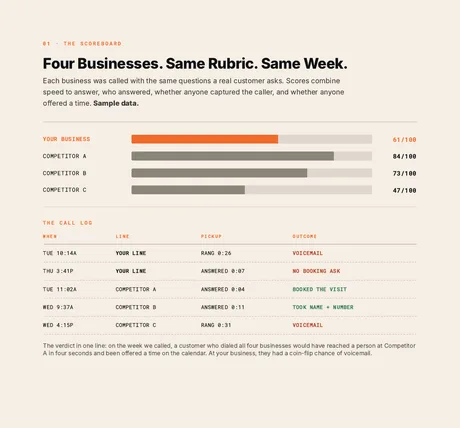 See a Sample Report (PDF)Six pages. Five recorded calls, one timed form fill, scored by AI against published standards.What it findsCalls ringing out to voicemailAnswered calls that never ask for the jobForm fills that wait hours for a humanThe competitor winning the first call
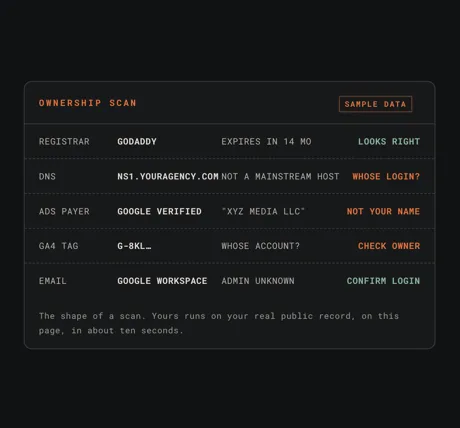 See What a Scan ReturnsPublic records read from the outside, in about ten seconds, with nothing to install.What it readsThe registrar, and when the domain expiresDNS, and whose nameservers those areThe business name paying for the adsThe GA4 tag and the email host
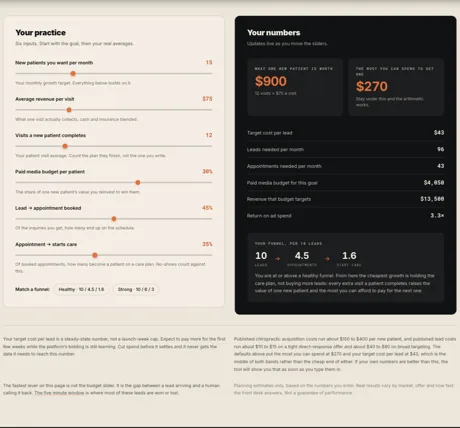 Run the NumbersSix sliders, figures that move as you drag them, and nothing you type leaves the page.What it works outWhat one new patient is worthThe most you can spend to win oneLeads and appointments you need a monthThe paid budget that hits the goal
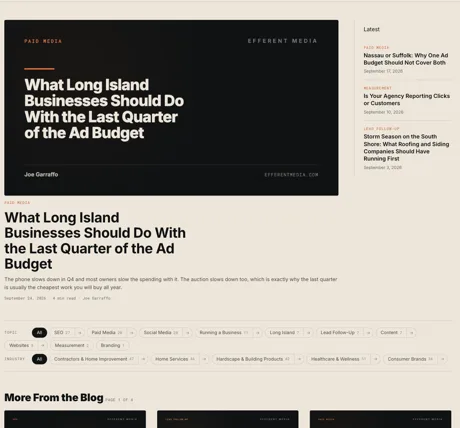 Read the LatestWritten off real Long Island accounts, the things we get wrong included.What it coversPaid media and budget decisionsSEO and the local map packLead follow-up and response timeRunning a Long Island business
See a Sample Report (PDF)Six pages. Five recorded calls, one timed form fill, scored by AI against published standards.What it findsCalls ringing out to voicemailAnswered calls that never ask for the jobForm fills that wait hours for a humanThe competitor winning the first call
See What a Scan ReturnsPublic records read from the outside, in about ten seconds, with nothing to install.What it readsThe registrar, and when the domain expiresDNS, and whose nameservers those areThe business name paying for the adsThe GA4 tag and the email host
Run the NumbersSix sliders, figures that move as you drag them, and nothing you type leaves the page.What it works outWhat one new patient is worthThe most you can spend to win oneLeads and appointments you need a monthThe paid budget that hits the goal
Read the LatestWritten off real Long Island accounts, the things we get wrong included.What it coversPaid media and budget decisionsSEO and the local map packLead follow-up and response timeRunning a Long Island business
Read the LatestWritten off real Long Island accounts, the things we get wrong included.What it coversPaid media and budget decisionsSEO and the local map packLead follow-up and response timeRunning a Long Island business
See a Sample Report (PDF)Six pages. Five recorded calls, one timed form fill, scored by AI against published standards.What it findsCalls ringing out to voicemailAnswered calls that never ask for the jobForm fills that wait hours for a humanThe competitor winning the first call
See What a Scan ReturnsPublic records read from the outside, in about ten seconds, with nothing to install.What it readsThe registrar, and when the domain expiresDNS, and whose nameservers those areThe business name paying for the adsThe GA4 tag and the email host
Run the NumbersSix sliders, figures that move as you drag them, and nothing you type leaves the page.What it works outWhat one new patient is worthThe most you can spend to win oneLeads and appointments you need a monthThe paid budget that hits the goal
Read the LatestWritten off real Long Island accounts, the things we get wrong included.What it coversPaid media and budget decisionsSEO and the local map packLead follow-up and response timeRunning a Long Island business
Long Island · Healthcare & Wellness
Practices that need patients, not just clicks.

What makes healthcare marketing different?
It is regulated advertising. Ad platforms restrict how you may describe a condition, which treatments you may promote, which drug and device names you may use, and what data you may send back about a patient. A single phrase on a landing page can restrict an entire ad account, and the restriction usually arrives without warning. So compliance is built into the copy, the pages and the tracking from the start rather than fixed after a disapproval.
Long Island practices where a single phrase on a page can restrict an entire account, and where nobody gets to learn that the hard way twice.
 New York Cancer & Blood Specialists
 East Bay Chiropractic Wellness
 Total Chiropractic Care
You guys have been great. I truly appreciate everything you guys have done.
“I will be referring my personal clients to EFFERENT.”
Benjamin H. Owens IIIVice President of MarketingThe part most agencies learn the hard way
Describing what a visitor is suffering from, implying you know their condition, promoting a treatment that is not approved for that indication, or using a trademarked device name you are not authorized for: each of these is an account-level risk, not an ad-level one.
Copy and landing pages screened before they run.
Send less. Renaming an event is evasion, not remediation.
The strongest single signal in a healthcare choice.
We have run medical accounts long enough to know where the lines are, and we screen for them before anything goes live. That is not caution, it is the cheapest insurance available on a practice's marketing.
What gets an account restricted
An ad rejection is noise you fix in an afternoon. An account-level restriction is an outage, it arrives without warning, and every one of these causes it.
The single largest cause of disapprovals in medical advertising, and it is almost always written with good intentions. Describe the service and who performs it. Never describe the person reading it.

Platforms review what the click lands on, not only what it said. A page that would not survive review is an account risk sitting behind a compliant ad.

Browser tags and remarketing pixels on pages with health intent send data that should never have left. That is a legal exposure wearing the costume of a measurement decision.

Building an audience from people who looked at a treatment page is building an audience out of health information. Renaming the event does not change what the data is, and a platform that restricts it is enforcing the rule we already hold.

Unanswered calls, slow callbacks and bookings nobody confirmed account for more lost patients than any targeting decision on the account.

Ask at the right moment, make it one tap, never incentivize. The timing does more work than the wording, and the rules here are not optional either.
How we run it
Five things, and the first one is not optional.
01 / 05
01
Copy, landing pages and imagery, against the failure modes that get accounts restricted. Ad-level rejections are noise. Account-level restrictions are an outage.
Screened before publication, every time
02
Standard browser analytics and remarketing tags do not belong on consult pages and treatment pages with forms. That is a data problem with legal consequences, not a marketing preference.
Top-of-funnel tracking only on health-intent pages
03
Not the form fill. A practice's real cost per patient runs through the front desk, and that is where most of the loss is.
04
The most common place a practice loses a patient it already paid for is a call that was not answered or a booking that was never confirmed.
05
In a healthcare decision they are close to decisive, and recency matters more than total count.
Where practices lose patients
Stage names are fixed. The counts are one sample month, replaced by the practice's own.
From search to booked appointment
Sample dataDIAGRAMWhat matters here
FAQ
Straight answers. If something is not here, ask us on the audit call.
Yes, within rules that are stricter than most categories and that change. The risk is not a rejected ad, it is an account-level restriction triggered by language or data that should never have been sent.
Copy that describes what the reader is suffering from. Negative self-perception language is the single largest cause of disapprovals in medical advertising, and it is usually written with good intentions.
No. Building an audience from people who looked at a treatment page is building an audience from health information, and it is exactly the thing the platform restrictions exist to stop.
If any patient information would be handled, yes, and it should be signed before anything starts. We verify this before an engagement rather than after.
Ask at the right moment, make it a single tap, and never incentivize. The timing does more work than the wording.
Usually the front desk, not the campaign. Unanswered calls, slow callbacks and unconfirmed bookings account for more lost patients than any targeting decision.
Let’s talk
Tell us about your business. We’ll show you where the growth is, within 48 hours.
Other industries
Roofing, siding, hardscape, remodeling. Including James Hardie contractors.
HVAC, heating oil, pest control, plumbing and the companies Long Island calls when something breaks.
Manufacturers and the dealer networks that sell for them.
Retail and direct to consumer, built on the same fundamentals as a local launch.
The deeper page for the one home-services trade where we can name four clients.
From the Blog
The same handful of findings show up in nearly every account we inherit. Here they are in order, so you can fix them yourself without hiring anyone.
Quotes that went quiet, last season's estimates, the week you were slammed. That list is the cheapest pipeline you own, and working it does not require hiring anybody.
Six weeks where your hours change twice and half the internet still shows the old ones. A customer who calls a number listed as open and gets nothing does not conclude you are closed.