Contractors & Home Improvement
Roofing, siding, hardscape, remodeling. Including James Hardie contractors.
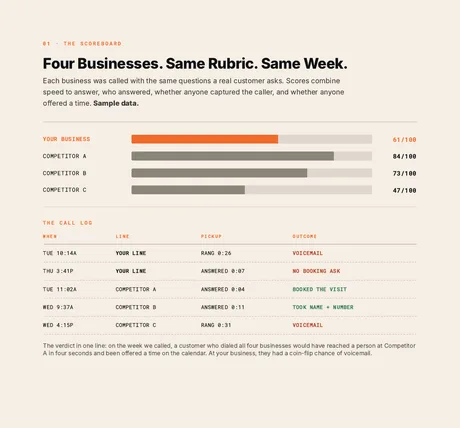 See a Sample Report (PDF)Six pages. Five recorded calls, one timed form fill, scored by AI against published standards.What it findsCalls ringing out to voicemailAnswered calls that never ask for the jobForm fills that wait hours for a humanThe competitor winning the first call
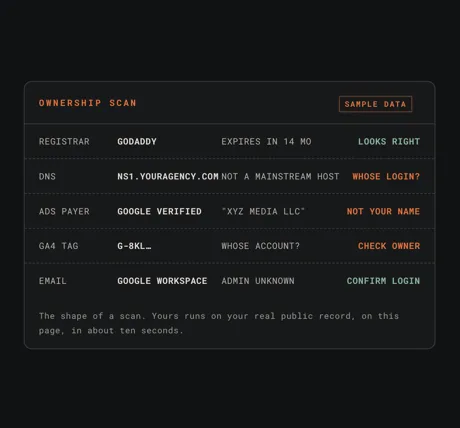 See What a Scan ReturnsPublic records read from the outside, in about ten seconds, with nothing to install.What it readsThe registrar, and when the domain expiresDNS, and whose nameservers those areThe business name paying for the adsThe GA4 tag and the email host
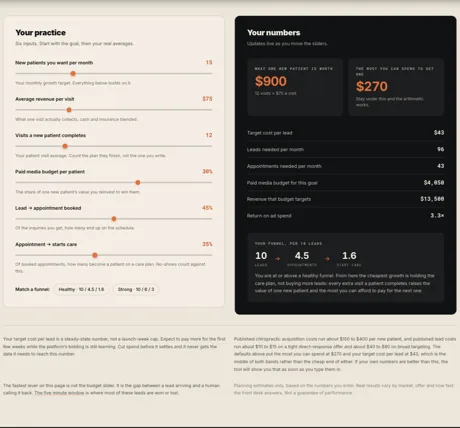 Run the NumbersSix sliders, figures that move as you drag them, and nothing you type leaves the page.What it works outWhat one new patient is worthThe most you can spend to win oneLeads and appointments you need a monthThe paid budget that hits the goal
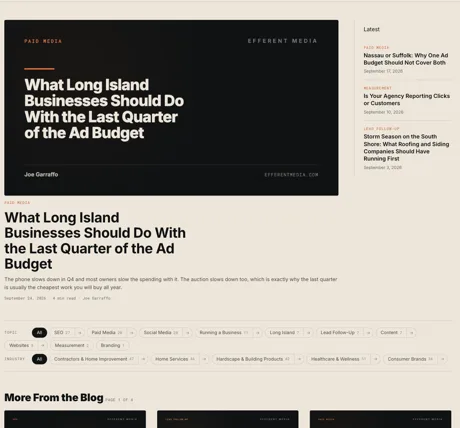 Read the LatestWritten off real Long Island accounts, the things we get wrong included.What it coversPaid media and budget decisionsSEO and the local map packLead follow-up and response timeRunning a Long Island business
See a Sample Report (PDF)Six pages. Five recorded calls, one timed form fill, scored by AI against published standards.What it findsCalls ringing out to voicemailAnswered calls that never ask for the jobForm fills that wait hours for a humanThe competitor winning the first call
See What a Scan ReturnsPublic records read from the outside, in about ten seconds, with nothing to install.What it readsThe registrar, and when the domain expiresDNS, and whose nameservers those areThe business name paying for the adsThe GA4 tag and the email host
Run the NumbersSix sliders, figures that move as you drag them, and nothing you type leaves the page.What it works outWhat one new patient is worthThe most you can spend to win oneLeads and appointments you need a monthThe paid budget that hits the goal
Read the LatestWritten off real Long Island accounts, the things we get wrong included.What it coversPaid media and budget decisionsSEO and the local map packLead follow-up and response timeRunning a Long Island business
Read the LatestWritten off real Long Island accounts, the things we get wrong included.What it coversPaid media and budget decisionsSEO and the local map packLead follow-up and response timeRunning a Long Island business
See a Sample Report (PDF)Six pages. Five recorded calls, one timed form fill, scored by AI against published standards.What it findsCalls ringing out to voicemailAnswered calls that never ask for the jobForm fills that wait hours for a humanThe competitor winning the first call
See What a Scan ReturnsPublic records read from the outside, in about ten seconds, with nothing to install.What it readsThe registrar, and when the domain expiresDNS, and whose nameservers those areThe business name paying for the adsThe GA4 tag and the email host
Run the NumbersSix sliders, figures that move as you drag them, and nothing you type leaves the page.What it works outWhat one new patient is worthThe most you can spend to win oneLeads and appointments you need a monthThe paid budget that hits the goal
Read the LatestWritten off real Long Island accounts, the things we get wrong included.What it coversPaid media and budget decisionsSEO and the local map packLead follow-up and response timeRunning a Long Island business
National · Retail & Direct to Consumer
National shelf presence built on the same fundamentals as a local launch.

What does Efferent Media do for consumer brands?
Performance media built around contribution margin rather than return on ad spend, retail support that protects sell-through, marketplace presence, and the brand creative that makes all of it cheaper. We have worked on brands that went from a Long Island office to a national acquisition. The fundamentals did not change on the way, only the budget.
The fundamentals did not change on the way up. Only the budget, the number of partners and how long a mistake runs before anybody sees it.
 SheaMoisture
 T-Mobile
 Madam C.J. Walker Beauty Culture
 Sky Organics
 Nubian Heritage
 Sundial Brands
 Unilever
 MET-Rx
The rhythm is different
A local service business can change an offer on Tuesday and know by Friday. A consumer brand has retail partners, inventory, seasonal resets and a marketplace to defend, and the feedback loop is measured in weeks.
Contribution per unit is the number that matters.
Retail partners judge you on velocity.
It is a media efficiency lever, not a vanity line.
That makes planning matter more and makes a single unmeasured channel much more expensive, because the mistake runs longer before anyone sees it.
By lever
A local service business changes an offer on Tuesday and knows by Friday. A brand finds out in six weeks, which is what makes the planning worth more than the optimization.

Return on ad spend is a platform reporting its own contribution with its own model. Contribution margin per unit is the number that survives contact with a finance team, and it usually reorders the whole channel mix.
Driving traffic to your own site while retail velocity falls is a way to lose the listing. The retail partner is judging a number you are not looking at.

Not on your site and not in a store aisle. Losing control of that page is losing control of the category, and it is won on content and reviews before it is won on bid.

In paid social, creative volume beats creative perfection. A pipeline that ships steadily outperforms any single production cycle, however good the asset was.
Brand spend lowers acquisition cost on everything else. Funded as a separate budget nobody measures, it is the first thing cut and the reason performance gets more expensive the following quarter.

Inventory, partners, seasonal resets and a marketplace to defend. The feedback loop runs in weeks, so an unmeasured channel is much more expensive here than it is locally: the mistake runs longer before anyone can see it.
How we run it
In that order of scrutiny, not necessarily of spend.
01 / 05
01
Return on ad spend flatters whichever channel sits closest to the purchase. Contribution margin per unit is the number that survives contact with the finance team.
The last click is the cheapest thing to take credit for
02
Retail partners judge you on velocity off the shelf. Driving traffic to your own site while your retail velocity falls is a way to lose the shelf.
03
For most brands the decision now happens on a marketplace search result. Losing control of that page is losing control of the category.
04
Brand spend is a media efficiency lever: it lowers acquisition cost on everything else. Treating it as a separate budget nobody measures is how it gets cut first.
05
In paid social, creative volume is the input that most reliably predicts the outcome.
What we watch
What gets reported against what decides anything
INTERFACE| What gets reported | What decides anything |
|---|---|
| Impressions | Qualified calls |
| Clicks | Forms with a real problem in them |
| Click-through rate | Cost per qualified lead |
| Keyword rankings | Booked jobs |
| Sessions | Revenue you can trace back |
What matters here
FAQ
Straight answers. If something is not here, ask us on the audit call.
Yes. The consumer brand work is national, and has included SheaMoisture, Unilever, MET-Rx and Sky Organics.
On contribution margin and incrementality, not on platform-reported return on ad spend. The platform is reporting its own contribution using its own model.
Yes, as part of the category picture. For many brands the marketplace search result is where the decision actually happens.
More than any single production cycle will comfortably produce, which is why the pipeline matters more than any individual asset.
Yes. Sell-through support, co-marketing and local demand generation around retail locations are part of the work.
From a founder-run brand doing its first national push to a portfolio brand inside a large parent company.
Let’s talk
Tell us about your business. We’ll show you where the growth is, within 48 hours.
Other industries
Roofing, siding, hardscape, remodeling. Including James Hardie contractors.
HVAC, heating oil, pest control, plumbing and the companies Long Island calls when something breaks.
Manufacturers and the dealer networks that sell for them.
Chiropractic, wellness and specialty practices that need patients, not just clicks.
The deeper page for the one home-services trade where we can name four clients.
From the Blog
The same handful of findings show up in nearly every account we inherit. Here they are in order, so you can fix them yourself without hiring anyone.
Six weeks where your hours change twice and half the internet still shows the old ones. A customer who calls a number listed as open and gets nothing does not conclude you are closed.
A report full of impressions and clicks is a report about the platform. Five questions that force it to be about your revenue instead, and what a straight answer to each one sounds like.