Strategy & Advisory
A senior strategist looking at the whole business, not just one campaign.
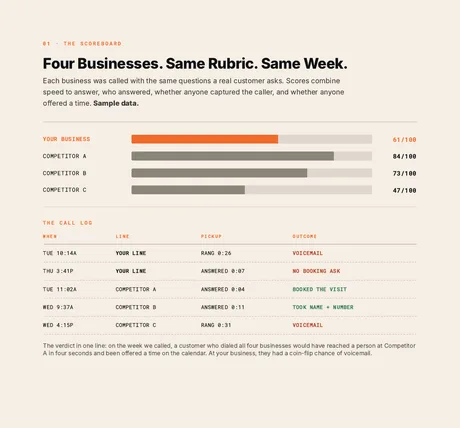 See a Sample Report (PDF)Six pages. Five recorded calls, one timed form fill, scored by AI against published standards.What it findsCalls ringing out to voicemailAnswered calls that never ask for the jobForm fills that wait hours for a humanThe competitor winning the first call
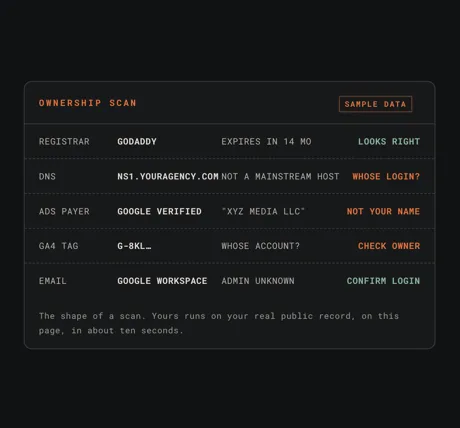 See What a Scan ReturnsPublic records read from the outside, in about ten seconds, with nothing to install.What it readsThe registrar, and when the domain expiresDNS, and whose nameservers those areThe business name paying for the adsThe GA4 tag and the email host
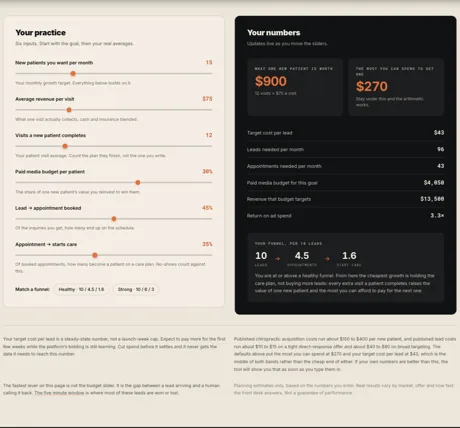 Run the NumbersSix sliders, figures that move as you drag them, and nothing you type leaves the page.What it works outWhat one new patient is worthThe most you can spend to win oneLeads and appointments you need a monthThe paid budget that hits the goal
 Read the LatestWritten off real Long Island accounts, the things we get wrong included.What it coversPaid media and budget decisionsSEO and the local map packLead follow-up and response timeRunning a Long Island business
See a Sample Report (PDF)Six pages. Five recorded calls, one timed form fill, scored by AI against published standards.What it findsCalls ringing out to voicemailAnswered calls that never ask for the jobForm fills that wait hours for a humanThe competitor winning the first call
See What a Scan ReturnsPublic records read from the outside, in about ten seconds, with nothing to install.What it readsThe registrar, and when the domain expiresDNS, and whose nameservers those areThe business name paying for the adsThe GA4 tag and the email host
Run the NumbersSix sliders, figures that move as you drag them, and nothing you type leaves the page.What it works outWhat one new patient is worthThe most you can spend to win oneLeads and appointments you need a monthThe paid budget that hits the goal
Read the LatestWritten off real Long Island accounts, the things we get wrong included.What it coversPaid media and budget decisionsSEO and the local map packLead follow-up and response timeRunning a Long Island business
Read the LatestWritten off real Long Island accounts, the things we get wrong included.What it coversPaid media and budget decisionsSEO and the local map packLead follow-up and response timeRunning a Long Island business
See a Sample Report (PDF)Six pages. Five recorded calls, one timed form fill, scored by AI against published standards.What it findsCalls ringing out to voicemailAnswered calls that never ask for the jobForm fills that wait hours for a humanThe competitor winning the first call
See What a Scan ReturnsPublic records read from the outside, in about ten seconds, with nothing to install.What it readsThe registrar, and when the domain expiresDNS, and whose nameservers those areThe business name paying for the adsThe GA4 tag and the email host
Run the NumbersSix sliders, figures that move as you drag them, and nothing you type leaves the page.What it works outWhat one new patient is worthThe most you can spend to win oneLeads and appointments you need a monthThe paid budget that hits the goal
Read the LatestWritten off real Long Island accounts, the things we get wrong included.What it coversPaid media and budget decisionsSEO and the local map packLead follow-up and response timeRunning a Long Island business
Service
Google Business Profile, reviews, citations and service-area pages built around where your trucks actually go.
Store actions driven
4,689Calls, directions and site visits, one campaign periodDriving directions
2,268Somebody asking their phone how to get to a storePhone calls
1,709Placed straight from the listingCost per website visit
$0.28Across 13,163 Long Island homeowners reachedHow do you rank in the Google map pack?
The map pack is three results, and position in it is decided mostly by proximity to the searcher, the relevance of your Google Business Profile to what they typed, and your review profile. That means the work is a correct primary category, a profile filled in properly, a steady flow of recent reviews that somebody actually answers, consistent citations, and a real page for each town you serve rather than one page for the Island.
What a local listing actually produces
Two thirds of what this campaign produced was somebody asking their phone for directions or dialling from the listing. Neither of those is a website session, and a report built only on sessions would have missed almost all of it.
Source: Aboff’s Paints, published at /case-studies/aboffs/.
How the three slots are decided
The map pack is three results. One of the three things deciding them is fixed before you start, which is exactly why the other two have to be stronger than the company down the road.
Drawn, not captured. Structural and unchanging, so nothing here goes stale.
Drawn from the profile’s own field list. Highlighted rows are the fields that actually move position.
What you actually see
Journey is our own portal. Reviews decide map pack position more than almost anything else you can control, so the page tracks velocity and recency rather than just the number on the profile.
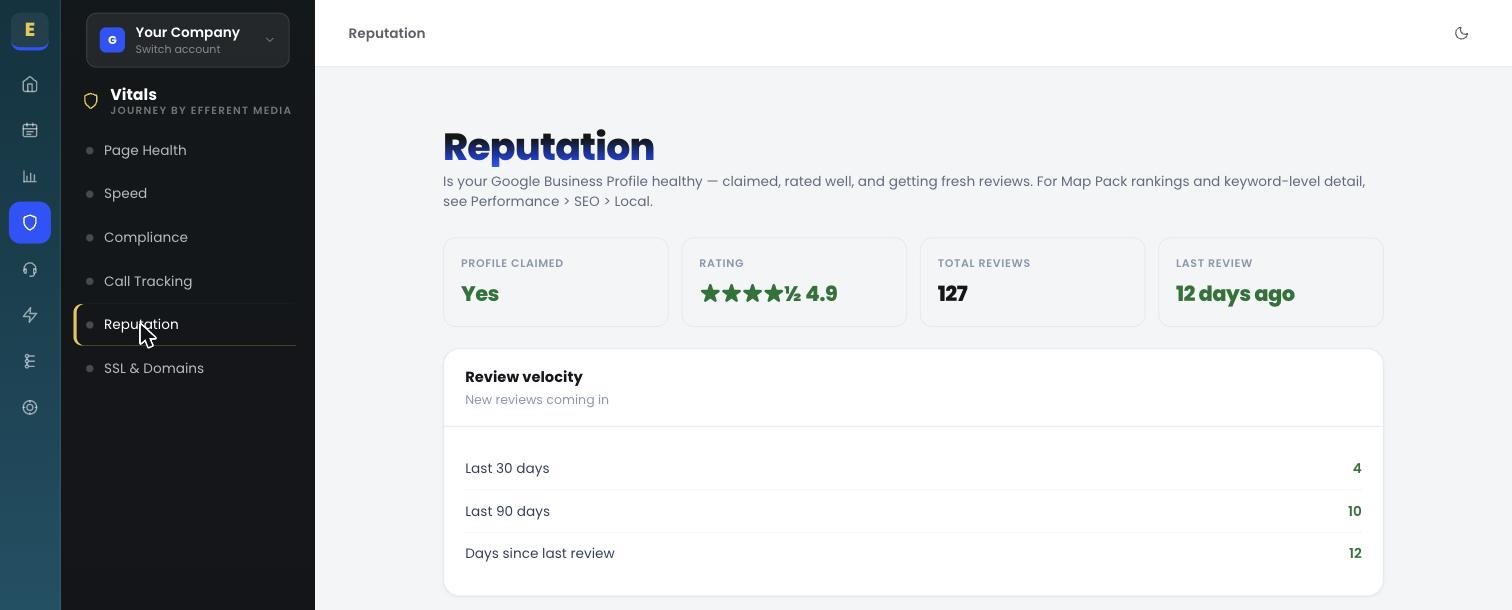
Journey is our own client portal. Every client gets a login on day one, and every figure on it traces to their own records rather than to a platform dashboard. Captured from a live client view with the account name, the login email and the client’s own domain replaced before the screenshot was taken.
How we run it
The first two are free and almost never done properly.
01 / 05
01
The single biggest lever in the whole system. The wrong primary category enters you in the wrong race, and you can be perfect at everything else and still not appear.
Checked first on every account
02
Services, products, attributes, questions and answers. Free relevance, sitting unused on most profiles in the category.
03
Volume, recency and whether a human answered. A review system that asks at the right moment beats one that asks everyone at the wrong moment.
Recency counts as much as volume
04
Name, address and phone identical across the directories that still carry weight. Not five hundred listings. The ones that matter, correct.
05
One per town you actually cover, with content that could only be about that town.
What we work on
Highlighted rows are the fields that actually move position. The rest matter for conversion once someone is looking at you.
Google Business Profile anatomy
DIAGRAMCoverage, town by town
REFERENCENassau County
Suffolk County
Twenty reviews from this year beats two hundred from 2019.How reviews are scored
Recency counts as much as volume, and whether a human answered counts too. A review system that asks at the right moment beats one that asks everyone at the wrong moment, which is most of them.

Scope
Why a radius does not work
A single service-area page targeting the whole Island is competing, in Huntington, against a company with a page about Huntington. It loses. Not because Google is unfair, but because the other page is more obviously the answer.
Real town pages mean real content about the town: the work you do there, the crews who cover it, the reviews from people who live there. A template with the town name swapped in is worse than nothing, because it is detectable and it is everywhere.
Nassau County
Suffolk County
The Nassau and Suffolk towns we build coverage around most often. One real page each, not one page with the town name swapped in.
More services
A senior strategist looking at the whole business, not just one campaign.
Google and Meta ads built to generate calls and booked jobs, not impressions.
Show up when Long Island customers search for what you do.
Fast, conversion-focused sites that turn visitors into leads.
FAQ
Straight answers. If something is not here, ask us on the audit call.
The ones your crews actually drive to, ranked by what a job there is worth. Coverage you cannot service is a customer service problem wearing a marketing costume.
In a local decision they are close to decisive, and recency counts as much as volume. Twenty reviews from this year beats two hundred from 2019.
Yes, every time, calmly and in public. The reply is not for the person who wrote it. It is for the next hundred people who read it.
It is harder, because proximity is a real ranking factor, but it is very achievable with genuine service-area coverage, reviews from that town and a real page for it.
A citation is a listing of your name, address and phone on another site. They matter less than they did, and inconsistency between them still actively hurts. The work is accuracy, not volume.
Category and profile fixes can move things within weeks. Building genuine coverage in a new town takes a quarter or more.

Let’s talk
Tell us about your business. We’ll show you where the growth is, within 48 hours.