You Decide
The constraint we point at, the budget, and the go or no-go at the end of the quarter are the owner’s calls. We bring the evidence, the recommendation and the disagreement. You own the business and you own the decision.
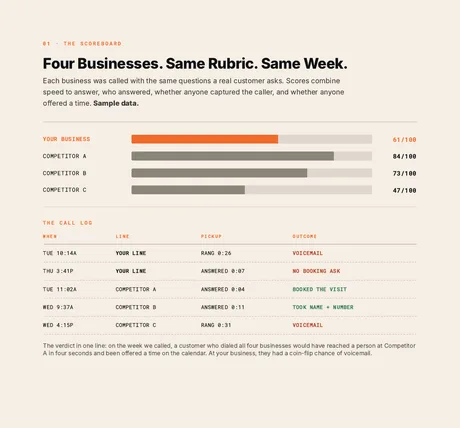 See a Sample Report (PDF)Six pages. Five recorded calls, one timed form fill, scored by AI against published standards.What it findsCalls ringing out to voicemailAnswered calls that never ask for the jobForm fills that wait hours for a humanThe competitor winning the first call
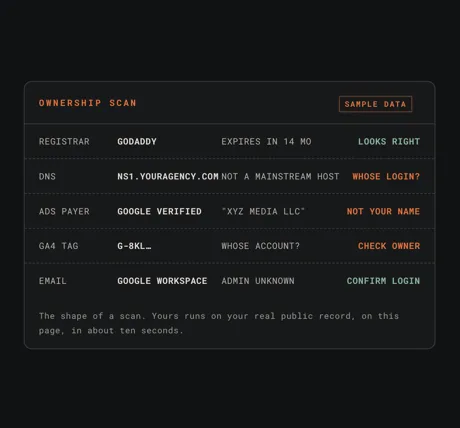 See What a Scan ReturnsPublic records read from the outside, in about ten seconds, with nothing to install.What it readsThe registrar, and when the domain expiresDNS, and whose nameservers those areThe business name paying for the adsThe GA4 tag and the email host
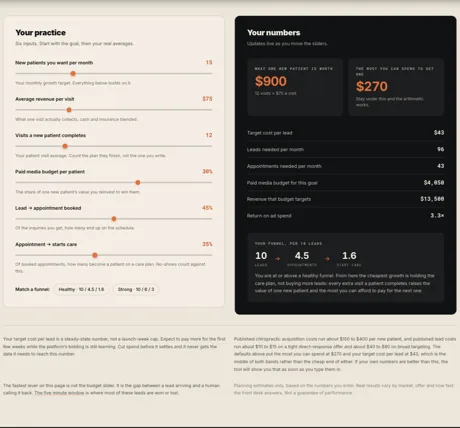 Run the NumbersSix sliders, figures that move as you drag them, and nothing you type leaves the page.What it works outWhat one new patient is worthThe most you can spend to win oneLeads and appointments you need a monthThe paid budget that hits the goal
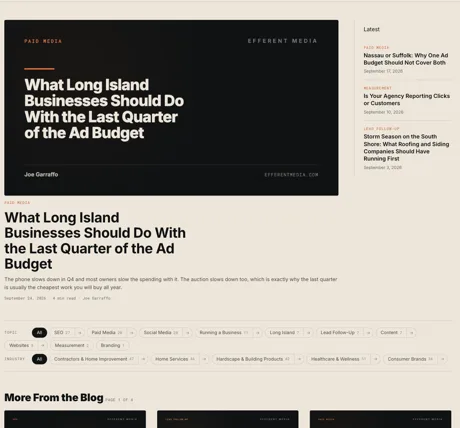 Read the LatestWritten off real Long Island accounts, the things we get wrong included.What it coversPaid media and budget decisionsSEO and the local map packLead follow-up and response timeRunning a Long Island business
See a Sample Report (PDF)Six pages. Five recorded calls, one timed form fill, scored by AI against published standards.What it findsCalls ringing out to voicemailAnswered calls that never ask for the jobForm fills that wait hours for a humanThe competitor winning the first call
See What a Scan ReturnsPublic records read from the outside, in about ten seconds, with nothing to install.What it readsThe registrar, and when the domain expiresDNS, and whose nameservers those areThe business name paying for the adsThe GA4 tag and the email host
Run the NumbersSix sliders, figures that move as you drag them, and nothing you type leaves the page.What it works outWhat one new patient is worthThe most you can spend to win oneLeads and appointments you need a monthThe paid budget that hits the goal
Read the LatestWritten off real Long Island accounts, the things we get wrong included.What it coversPaid media and budget decisionsSEO and the local map packLead follow-up and response timeRunning a Long Island business
Read the LatestWritten off real Long Island accounts, the things we get wrong included.What it coversPaid media and budget decisionsSEO and the local map packLead follow-up and response timeRunning a Long Island business
See a Sample Report (PDF)Six pages. Five recorded calls, one timed form fill, scored by AI against published standards.What it findsCalls ringing out to voicemailAnswered calls that never ask for the jobForm fills that wait hours for a humanThe competitor winning the first call
See What a Scan ReturnsPublic records read from the outside, in about ten seconds, with nothing to install.What it readsThe registrar, and when the domain expiresDNS, and whose nameservers those areThe business name paying for the adsThe GA4 tag and the email host
Run the NumbersSix sliders, figures that move as you drag them, and nothing you type leaves the page.What it works outWhat one new patient is worthThe most you can spend to win oneLeads and appointments you need a monthThe paid budget that hits the goal
Read the LatestWritten off real Long Island accounts, the things we get wrong included.What it coversPaid media and budget decisionsSEO and the local map packLead follow-up and response timeRunning a Long Island business
Service
We read demand, capture and follow-up as one system, name the single thing holding it back this quarter, and write the plan that quarter gets graded against.
Starts with
An auditWritten by a person and delivered in 48 hours, before there is anything to signJudged on
CustomersBooked jobs and kept appointments. Never leads, never rankingsCriteria
Written firstWhat the quarter should move, agreed before it starts rather than afterAccounts and data
YoursYour ad accounts and every row of your data, in writingDo I need a marketing strategist, or just someone to run the ads?
If you already know which number is holding the business back, hire an operator and point them at it. Most owners do not know, and the way they find out is by spending a year improving something that was never the constraint. Strategy is the work of reading demand, capture and follow-up as one system, naming the one thing limiting it right now, and being wrong out loud when the evidence says so. Execution is cheaper and faster once it is aimed at the right thing.
Plain terms
Advisory is the part of the engagement that decides what to do. Not how to write the ad or which bid strategy to run, but which problem is worth the next ninety days, what winning would look like in your own records, and what we agree to stop doing to pay for it.
It sits above the channels rather than beside them. Paid search, SEO, local, social, the site and the follow-up system all run against the same plan, which is the only way to stop each one optimizing for the number that flatters it. A channel graded on its own metrics will always look like it is working.
It is not a deck. Nobody on Long Island needs another forty-slide roadmap. What an owner needs is one page they can hold up at the end of the quarter and check.
The shape of the work
Every engagement runs on the same four beats, and the last one is the reason the first three are worth anything. A plan with no scheduled verdict is a plan that can never be wrong, and a plan that can never be wrong cannot teach anybody anything.
This quarter’s constraint Working, and not where the quarter goes
01 / 04
01
What the business produces today, counted end to end: demand in your towns, what reaches the site, what calls, what books and what gets signed. Recorded before a single thing is changed, because a baseline taken afterwards is a number nobody can argue with.
Measured before anything is touched
02
One step in that chain is narrower than the rest and it is setting the ceiling for everything above it. Widening any other step moves nothing and costs the same money.
The narrowest step, not the loudest one
03
What we are going to do, what it should move, by how much, and by when. The criteria are written now, while nobody knows the answer, and they are the ones we get graded on.
Agreed before the quarter starts
04
At the end of the quarter we read the result against the criteria as written, including the calls that did not work. Then the constraint is named again, because it usually moves.
Including what we got wrong
The case for it
A channel specialist is paid to make one channel look good, and a competent one always can. Cost per lead falls because the lead got cheaper and worse. Rankings climb on phrases nobody in your county types. Impressions rise because impressions always rise. Every one of those is a real improvement to a number that has stopped being connected to the business.
The connected version is harder and duller. It asks what a booked job costs you, how many of them the business can actually deliver this year, and which step between a search and a signed contract is leaking the most. Those questions do not belong to any one channel, which is exactly why nobody owns them by default.
That is the argument for a strategist in the room: one person whose job is the number at the end, who is allowed to say the budget should go down.

The line we hold
An advisory relationship is worth having only if it can tell you something you did not want to hear. The left column is what you are buying. The right column is what a vendor paid by the media spend offers instead, and it is why most marketing plans survive their first bad month by quietly changing what they were measuring.
The idea the work runs on
A business that turns strangers into customers is a chain, and a chain has one weakest link. Pour more demand onto a business whose phone is not answered after five and you have bought your competitors a busier week. Fix the phone on a business nobody in its towns can find and nothing rings. Both are real improvements. Only one of them is this quarter’s.
So the first job is not a recommendation, it is a diagnosis, and it is usually unwelcome. We have found the constraint sitting in a call that rang out to voicemail at 4:58, in a form that dropped the click id so every paid lead reported as direct, in a map listing whose categories were set once and never revisited, and in a sales process that quoted four days after the appointment. None of those were the channel the owner called us about.
A constraint that gets fixed does not leave a gap, it hands the ceiling to whatever was second, which is why this is a standing quarterly question rather than a one-time engagement.
Where it shows up
Read as five steps rather than five channels, a business usually has one drop that is much worse than the others. It is rarely the step the owner is worried about, and it is almost never the one an agency is being paid to improve.
Five steps between a search and a signed job
Sample dataCHARTThe verdict
Deciding what success looked like after the money is spent is how every plan in this industry gets to have worked. The criteria are written down first for that reason. Four reads, together, because any one alone can be made to say whatever the presenter needs.
The single measure the quarter was pointed at, before against after, on the definition agreed at the start. A definition that moved during the quarter invalidates the read and we say so rather than quietly restating it.
Quoted back in the words they were written in. If we met three of five, the review says three of five. Partial is a legitimate answer and it is a more useful one than a rounded up success.
Spend against the movement, so the next decision is about whether the trade was worth repeating rather than about whether the number went up. Plenty of numbers go up for money.
The calls that did not work, named, in the same document as the ones that did. An advisor with no losing recommendations in the record is an advisor who is not writing them down.
The verdict is one of three words: continue, redirect or stop. Stopping is a legitimate outcome and it is on the table before you spend anything, which is the difference between an advisor and a vendor.
Who does what
An advisory engagement works when the decision rights are obvious. These are the three, and the first one is not negotiable.
The constraint we point at, the budget, and the go or no-go at the end of the quarter are the owner’s calls. We bring the evidence, the recommendation and the disagreement. You own the business and you own the decision.
Demand, capture, conversion and follow-up, read together and re-read every quarter. Our job is the number at the end and the honesty of the review, including the part where we were wrong.
Paid search, SEO, local, paid social, streaming and the site run against the same written plan rather than each optimizing for the metric that flatters it. That is the only reason the plan means anything once the quarter starts.
If you already have an in-house marketer or an agency you like, this layer sits above them. A good operator with a clear constraint outperforms a new vendor with none.
How it starts
Every engagement here starts the same way. You send a two-minute form, we spend about two hours building a written audit of your competitors, your wasted spend and the demand nobody in your category is capturing, and it is in your hands within 48 hours.
Only then is there a call, and it is thirty minutes to walk through what we found. There is no card, no contract and no discovery call standing between you and the document. If we are not the right fit we say so on that call. The audit is also the first half of the work: the baseline in step one comes out of it.
The rhythm
No mystery, and no standing meeting that exists to justify itself. This is the whole cadence.
Between those, we are reachable. An advisory relationship that only exists on review day is a subscription to a document.
Scope
Ownership
The ad accounts, the platform seats, the analytics, the written plan and every row of performance data belong to your company from day one, and the agreement says so. That matters more here than anywhere else on this site: an advisory relationship that leaves you unable to act without the advisor has quietly become the constraint. If we ever part ways you keep the plan, the baseline and everything the work learned.
More services
Google and Meta ads built to generate calls and booked jobs, not impressions.
Show up when Long Island customers search for what you do.
Own the map pack in the towns you actually serve.
Fast, conversion-focused sites that turn visitors into leads.
FAQ
Straight answers. If something is not here, ask us on the audit call.
It sits above them. Most clients have us do both, and the advisory layer is what the channel work runs against. If you already have an agency or an in-house marketer you like, this layer works over them.
A baseline of what the business produces today, the constraint named in writing, a plan with the criteria it will be graded against, and a quarterly verdict read back against those criteria as written.
Then that is the recommendation, and it has been made before. An advisor who cannot say the budget should go down is a vendor.
One quarter. The baseline is week one, the constraint is week two, and the verdict is at the end of the ninety days.
Yes, end to end: ad platforms, analytics, the CRM and whatever records booked jobs. A baseline built from ad platform data alone is the problem this service exists to fix.

Let’s talk
Tell us about your business. We’ll show you where the growth is, within 48 hours.