Get Your Free Audit →

Free · Instant · Nothing to fill in

What Is One New Chiropractic Patient Actually Worth?

Most practices buy leads without ever doing this arithmetic, which is why a good month and a bad month feel like luck. Six numbers you already know give you the value of one new patient, the most you can spend to win one, and the paid media budget it takes to hit your goal. It runs here, on this page, and we never see what you type.

At the defaultsWorked example
ONE VISIT$75COLLECTED 
PLAN COMPLETED12 VISITSPVA 
NEW PATIENT VALUE$900FIRST PLANTHE NUMBER
MOST YOU CAN SPEND$27030% OF VALUECEILING
TARGET PER LEAD$43AT 45% / 35%BID TO THIS
TO ADD 15/MO96 LEADS43 APPTSTHE REAL ASK

The calculator

Six Numbers You Already Know.

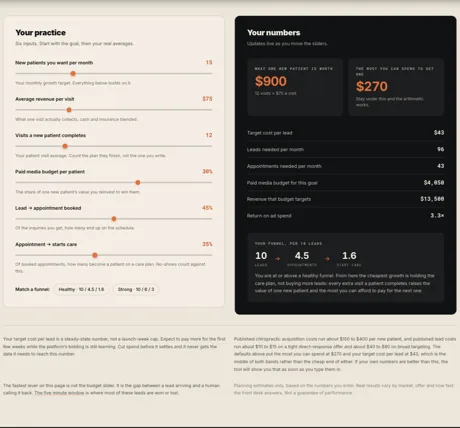
Nothing here is looked up and nothing is sent anywhere. Move the sliders to your own practice and every figure on the right recalculates as you go. Rough is fine. The point is the shape, and the shape is usually the surprise.

Your practice

Six inputs. Start with the goal, then your real averages.

15

Your monthly growth target. Everything below builds on it.

$75

What one visit actually collects, cash and insurance blended.

12

Your patient visit average. Count the plan they finish, not the one you write.

30%

The share of one new patient’s value you reinvest to win them.

45%

Of the inquiries you get, how many end up on the schedule.

35%

Of booked appointments, how many become a patient on a care plan. No-shows count against this.

Match a funnel:

Your numbers

Updates live as you move the sliders.

What one new patient is worth    
The most you can spend to get one   Stay under this and the arithmetic works.
Target cost per lead
 
Leads needed per month
 
Appointments needed per month
 
Paid media budget for this goal
 
Revenue that budget targets
 
Return on ad spend
 
Your funnel, per 10 leads
 Leads
 Appointments
 Start care


Your target cost per lead is a steady-state number, not a launch-week cap. Expect to pay more for the first few weeks while the platform’s bidding is still learning. Cut spend before it settles and it never gets the data it needs to reach this number.

Published chiropractic acquisition costs run about $150 to $400 per new patient, and published lead costs run about $10 to $15 on a tight direct-response offer and about $40 to $80 on broad targeting. The defaults above put the most you can spend at $270 and your target cost per lead at $43, which is the middle of both bands rather than the cheap end of either. If your own numbers are better than this, the tool will show you that as soon as you type them in.

The fastest lever on this page is not the budget slider. It is the gap between a lead arriving and a human calling it back. The five minute window is where most of these leads are won or lost.

Planning estimates only, based on the numbers you enter. Real results vary by market, offer and how fast the front desk answers. Not a guarantee of performance.

What actually moves it

Three Numbers Decide What You Can Afford.

Almost every chiropractor who thinks advertising does not work for him is looking at a cost per lead and not at these three. Fix any one of them and the same ad budget buys more patients.

01

The Plan They Finish.

Value is revenue per visit times visits completed, and the second half is the one that moves. A patient who finishes eighteen visits instead of twelve is worth half again as much, which raises the most you can afford to pay for the next new patient by exactly the same half. Retention is an advertising lever, and it is cheaper than any of the others.

02

The Call You Did Not Return.

A lead that never becomes an appointment costs the same as one that does. The gap between a form arriving and a person calling it back is the single most expensive number in most practices, and it never shows up on an ad platform report. Move the booking rate five points and watch the leads needed fall.

03

The Chair That Stayed Empty.

A booked appointment that no-shows is a lead you paid for, a slot you held, and no patient. It is folded into the second stage on purpose, because a practice that tracks booking and show separately usually tracks neither. Reminders and a real confirmation call are the cheapest patients you will ever buy.

A chiropractor explaining a care plan to a patient at a desk

Value per patient is the ceiling on every other number.

Why the number matters

A Budget Without This Number Is a Guess With a Decimal Point.

Ask ten chiropractors what they can afford to spend on a new patient and nine will answer with a feeling. The tenth has done this multiplication, and he is the one who can tell you in a sentence whether last month worked.

It is not a hard sum. It is just one almost nobody runs, because the two halves live in different places: revenue per visit is in the practice management software and visits completed is in somebody’s head. Put them together and the ceiling on every marketing decision you make becomes a number instead of an argument.

The practice the arithmetic is about

A Calculator Is a Picture of a Waiting Room.

Every figure in the tool above is a real thing happening in a real office: a phone answered, a chair filled, a plan completed. The numbers are only useful because you can walk out front and see them.

A patient checking in at a chiropractic clinic reception desk
The first appointmentEverything on this page happens before this moment. The lead, the call back, the confirmation. This is the only part a patient remembers.
A chiropractor treating a patient on a treatment table
The visit that sets the valueOne visit is one number. The plan they complete is the number that decides what you can afford to pay for the next new patient.
A chiropractor working on a seated patient's upper back
The plan they finishTwelve visits is the common average. Retention data says a quarter of patients stop before the active plan is done, and that quarter is pure lost value.

The photographs in this section are AI-generated illustrations. They are not photographs of real patients, real clinics or clients of Efferent Media.

A patient waiting in a chiropractic clinic waiting room

We Built This for the Practices We Already Work With.

Efferent Media has been family owned and run out of Lindenhurst since 2011, and healthcare and wellness has been one of our five lanes the whole time. This is the same arithmetic we run on a client account before we recommend a budget, with the numbers left open so you can put your own in.

One rule has never moved here: the client owns the ad account, the analytics and the data. If you want the same math run against your real numbers rather than your estimates, that is what the free audit is.

Get the Free Audit →

FAQ

Asked Before Every Budget Conversation.

Straight answers. If something is not here, ask us on the audit call.

What is a new patient actually worth in a chiropractic practice?

Revenue per visit multiplied by the visits that patient completes. A practice collecting $75 a visit from a patient who finishes a twelve visit plan is looking at $900 for that first course of care. Continuing care after the plan is real money and this tool deliberately ignores it, because a budget built on the visits you hope for is a budget that overspends.

Where do the default numbers come from?

Published chiropractic figures, set at the conservative end. Cash visits are commonly published around $65 to $80 and the MEPS derived mean per visit is about $87, so the tool defaults to $75. Patient visit average is commonly published around twelve. Acquisition cost is published at roughly $150 to $400 per new patient, and the default budget share puts the ceiling at $270, which is the middle of that range rather than the cheap end.

Why is the budget default 30 percent and not 20?

Because the published cost of acquiring a chiropractic patient says so. Our own budgeting standard is about 20 percent of gross revenue for a practice that intends to grow, and it moves up where published acquisition costs demand it. Against a $900 first course of care, the published midpoint acquisition cost is about 30 percent. Setting it lower would make the tool tell you patients are cheaper than they are.

Is my data sent anywhere?

No. The whole tool is arithmetic running in your own browser. There is no form, no submit, no network request, and nothing you type leaves the page. Close the tab and it is gone.

My cost per lead is much lower than this. Am I doing something wrong?

No, you are doing something right, and you should type your real number in. The defaults are set so the tool never promises the cheap case. A practice with a tight direct response offer and a front desk that answers can run well under them, and that shows up immediately as a bigger budget you can justify.

What should I do with the result?

Compare the target cost per lead to what you are actually paying, and compare the leads needed to what you are actually getting. The gap tells you whether your problem is media, the front desk, or the care plan. Those are three different problems with three different fixes, and most practices spend money on the first one when the answer is the second.
Free · Instant · Nothing to fill in

Run It Against Your Own Practice.

Six sliders, no form, no email, nothing stored. If the number that comes out is uncomfortable, that is the useful outcome.

Run the Numbers →