 See a Sample Report (PDF)
 See What a Scan Returns
 Run the Numbers
 Read the Latest
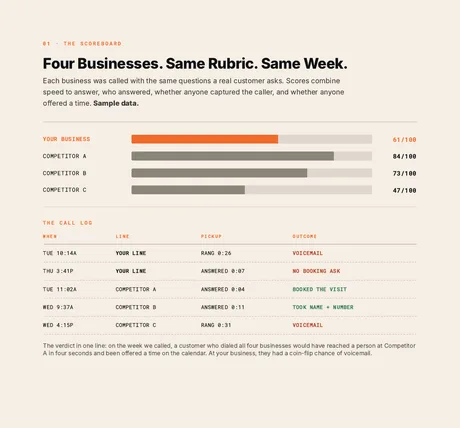
Speed is the cheapest improvement available to almost every business we look at, and it is almost never a marketing problem. It is a routing problem. The lead arrives, it sits in an inbox nobody is watching, and by the time somebody calls, the person has already spoken to two other companies.
You do not need a better ad to fix that. You need the message to reach a human faster than it currently does.
Why the Window Is So Short
A person filling out a form at nine on a Sunday night is not shopping calmly. They have a leak, a quote to compare, a decision they finally sat down to make. That intent is at its highest the moment they hit submit and it decays from there, quickly at first.
They also rarely fill out one form. Most fill out three. The order the replies arrive in has more to do with who gets the job than almost anything on the three websites they visited, because the first real conversation reframes the other two as second opinions.
So the competitive question is not whether your follow-up is good. It is whether it is first.
Where the Time Actually Goes
When we audit this on a live account, the delay is almost never the person. It is the path the lead takes to reach them. The usual culprits, in the order we find them:
- The form goes to one inbox, and that inbox belongs to somebody who is on a roof. Nothing is wrong with the form. It is doing exactly what it was configured to do in 2021.
- Notifications are off. The lead arrives in a system that would alert somebody, if anybody had enabled the alert.
- Nobody owns it after hours. Weeknights and weekends are a third of the week and more than a third of the leads, and on most accounts we look at, nothing at all happens in that window.
- It went to spam. This one is worth checking today rather than reading about. It is more common than anyone expects and it is completely silent.
- The phone number on the ad rings a line nobody answers. Which is its own category of problem, and a bigger one, because a missed call leaves no record to follow up at all.
Every one of these is fixable in an afternoon, and none of them requires a bigger team.
The Setup That Actually Holds
Four pieces, in order of how much they change.
One: an immediate automatic acknowledgment. Text and email, sent within a minute of the form. It should do three things and stop: confirm the message arrived, say who will be in touch, and say when. "Thanks, we got this. Joe will call you within the hour, or first thing tomorrow if it is after 6." That is the whole message. It is not a sales pitch and it should not read like one.
Two: an alert that reaches a phone, not an inbox. Text or push. An email notification is an alert only for someone at a desk, and the people who close your work are usually not at a desk.
Three: a named owner per window. Weekdays, evenings, weekends. Not a rota nobody wrote down. If the honest answer for Sunday is "nobody", then Sunday's automatic reply should say Monday morning, because a promise you keep beats a promise that sounds better.
Four: a follow-up sequence that does not stop at one attempt. Most companies try once and treat silence as a no. Silence is usually a person who was busy when you called. A short sequence over several days, mixing text and phone, recovers a meaningful share of leads that the first attempt missed. We wrote about the larger version of this in the follow-up systems we build.
Answering Is Not the Same as Converting
Worth separating, because the two get measured together and fixed separately. Speed gets you the conversation. What happens in the conversation is a different skill, and a fast call handled badly is still a lost job.
But the order matters. You cannot improve a conversation that never happens, and on most of the accounts we take over, a real share of the leads never produced a conversation at all. That is the cheapest thing on the list to fix and it is almost always the first thing we fix.
How to Check Your Own This Week
Fill out your own form. Use your own phone, a real name, a real number, outside business hours. Then sit with it and note the time on three things: when the automatic reply arrived, when a human made contact, and through which channel.
Do it once for the website form and once by calling the number on your ads. Most owners who run this test find something they did not know, and about a third find something actually broken.
If you want somebody else to run it, that check is part of the free marketing audit. We do it on every account before we look at anything else, because there is no point improving traffic into a path that loses it.
Frequently Asked Questions
- What if we cannot answer within five minutes?
- Then answer automatically within five minutes and have a person follow within the hour. An immediate acknowledgment that sets a real expectation holds the lead far better than silence followed by a good call two days later.
- Does an automated first reply feel impersonal?
- Less impersonal than not replying. The version that reads badly is the one pretending to be a person. Say plainly that the message arrived, name who will call and roughly when, and keep it short.
- Should we call or text first?
- Text first, call second, for anyone who submitted a web form. They chose a typed channel. A text gets read; an unknown number at dinnertime often does not get picked up.