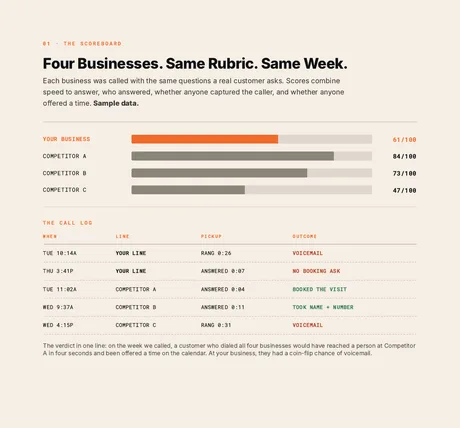
 See a Sample Report (PDF)
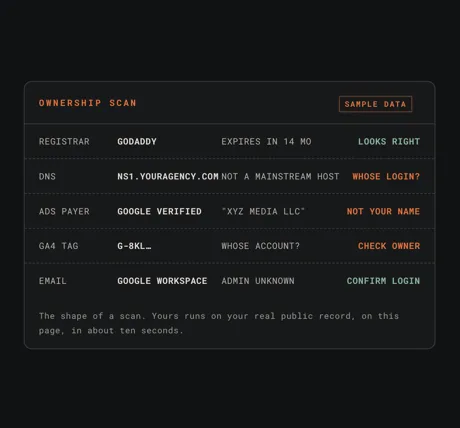 See What a Scan Returns
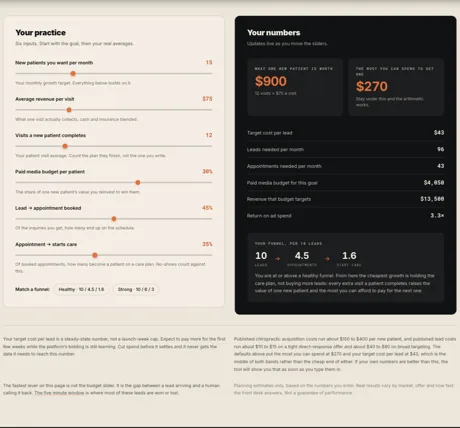 Run the Numbers
 Read the Latest
A marketing report is a claim about what your money did. Most of them are a claim about what a platform did, which is a different and much smaller statement, and the difference is easy to miss because the second one is full of numbers.
Impressions, clicks, click through rate, cost per click. Every one of those is true, verifiable, and produced by the ad platform without anyone at the agency doing anything. They describe the auction. They do not describe your business.
The numbers that describe your business all live downstream of the click, inside your phone system, your inbox and your schedule, where the platform cannot see. Getting them into the report is work, and whether that work has been done is the single clearest signal of what kind of relationship you are in.
The Five Questions
Ask these in your next reporting call. They are not gotchas and a good agency will welcome them, because most of them are questions they have wanted you to ask.
One: how many of last month's leads were real? Not how many form fills. How many were a genuine person with a relevant need. Every channel produces junk and channels differ enormously in how much, so a lead count with no qualification step behind it flatters exactly the channels that deserve it least. A straight answer sounds like a number, a definition, and who applied it.
Two: what did a qualified lead cost, by channel? The moment the junk is removed, channels that looked identical stop being identical. This is usually the first number that changes somebody's mind about where the budget goes.
Three: how many became jobs? This is the rung where the agency needs something from you, and the answer tells you whether they have asked. "We do not have that" is an acceptable answer exactly once, and the next sentence should be a plan for getting it.
Four: which number in this report can you not verify? Every report contains at least one estimate. Analytics attribution is modeled. Call tracking misses calls placed from a saved contact. Offline conversions arrive late. None of that is a scandal, and all of it should be labeled. An agency that presents every figure with the same confidence has either not looked or is hoping you will not.
Five: what would you change if this were your money? The answer separates a vendor from an operator faster than any metric. A vendor describes what they did. An operator has an opinion about what to do next and a reason attached to it.
What a Good Report Is Shaped Like
Short. One page of numbers, and a paragraph saying what changes next month and why.
The numbers, in the order they matter:
- Spend, by channel.
- Qualified leads, by channel, with the qualification rule stated somewhere on the page.
- Cost per qualified lead, by channel.
- Jobs or customers, by channel, wherever the connection exists.
- What changed since last month, in a sentence, with a cause rather than an observation.
Everything else is available on request and does not belong on the page. Impressions belong in an appendix. A report that leads with impressions has led with the least consequential number it contains.
The Under-Count Is the Dangerous Direction
One asymmetry worth internalizing, because it decides which errors hurt.
An inflated number invites scrutiny. Somebody looks at fifty leads, recognizes that the phone did not ring fifty times, and asks. The error gets caught.
A low number reads as bad news about the business and gets acted on. A channel that is under-counted because its tracking is broken looks like a channel that is not working, and the response is to cut it. Nothing on the screen distinguishes a coverage gap from a genuine zero. They render identically.
So when a channel's number looks wrong, the first question is whether the measurement can see it at all, not whether the channel works. We are wrong about this ourselves often enough that it is now the first thing we check rather than the last.
Where This Gets Built
Connecting spend to jobs is not exotic and it is not a platform feature you switch on. It is a project: a way to capture how each lead arrived, a way to mark what happened to it, and a way to send that outcome back to the platforms that need it to bid properly.
It takes a few weeks and it changes every decision made afterward, because for the first time the budget conversation is about revenue instead of about clicks.
If you want to know what your own reporting can and cannot currently see, that assessment is part of the free marketing audit. We do it whether or not you work with us, and the finding is frequently that the answer was available all along and nobody had connected the two halves.
Frequently Asked Questions
- Is it unreasonable to ask an agency for cost per job?
- No, but it is reasonable for them to need your data to produce it. Everything after the lead happens inside your business, where no ad platform can see. The fair version of the question is whether they have asked you for that data and built the connection.
- What if my sales process is too messy to track?
- Then the first project is the tracking, not the ads. Messy is normal and it is fixable. What is not workable is spending against a funnel nobody can see, because every optimization after that is a guess with a budget attached.
- How often should reporting arrive?
- Monthly for the numbers, with anything urgent raised when it happens rather than held for the report. A report is a record. It is not the alerting system, and an agency that only talks to you on reporting day is not watching the account.