 See a Sample Report (PDF)
 See What a Scan Returns
 Run the Numbers
 Read the Latest
You can build a defensible marketing budget without knowing what last year produced. It takes about two hours and four numbers you already have, and the version you get is better than the alternative, which is either repeating last year's figure or picking a percentage out of the air.
This is the single most common state we find a business in at planning time. Spend by channel is available because the platforms keep it. Revenue is available because the accountant keeps it. Nothing connects the two, so the honest answer to "what did marketing produce" is that nobody knows.
That is a problem to fix. It is not a reason to plan badly in the meantime.
Start From Capacity, Not From Spend
The question most budgets start with is how much can we afford to spend. That is the wrong end.
Start here instead: how much work can you actually deliver next year. Crews, chairs, trucks, hours, whatever your constraint is. Then work backward.
- Jobs you can deliver. Not jobs you want. Jobs your capacity supports, honestly, allowing for the weeks nobody works.
- Jobs that arrive without marketing. Referrals, repeat customers, the phone that rings because you have been here fifteen years. This number is larger than most owners think and it is the reason many businesses overestimate what their advertising is doing.
- The gap. What is left is the work marketing has to produce. That is the actual target, and it is usually a much smaller number than the total, which changes the budget conversation considerably.
- Your average job value and your close rate. Both are in your own records.
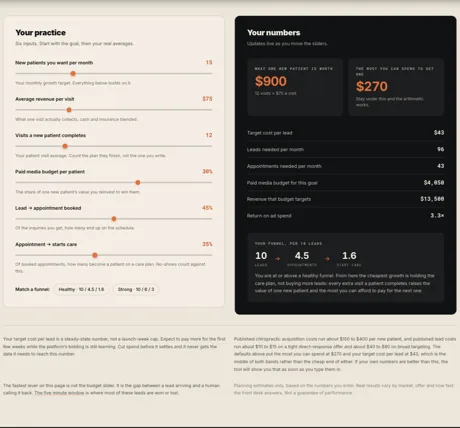
From those four you can derive how many qualified leads you need, and from there the budget is arithmetic rather than instinct.
The Number You Are Missing Is Cost Per Qualified Lead
That is the one piece that has to be estimated, and there are three honest ways to get it, in descending order of confidence.
From your own history, partially. Even without full attribution, most businesses can reconstruct a quarter. Pick the busiest quarter, pull the spend, count the leads that were genuinely real, divide. It is one quarter of one year and it is enormously better than nothing.
From your platform's own number, adjusted. Take the platform's reported cost per conversion and adjust it down for junk. If you do not know your junk rate, sample fifty leads by hand. Fifty is enough to see the shape and it takes an afternoon.
From a range, labeled as a range. If neither is available, use a band rather than a point, and plan against the pessimistic end. A budget built on the optimistic end of an estimate is a budget that runs out in August.
Whichever you use, write down which one it was. A number whose provenance is recorded can be improved next year. A number whose provenance was forgotten becomes folklore, and in three years somebody will be defending it without knowing where it came from.
Shape the Year, Do Not Flatten It
The most common structural mistake is dividing the annual figure by twelve.
Almost no business here has flat demand. The trades have a spring rush and a winter trough. Heating has the opposite. Retail has Q4. A flat budget overspends in the months where demand is not there and underspends in the months that decide the year.
Shape it against your own seasonality, which you can read directly off last year's revenue by month. Then apply two adjustments:
- Spend ahead of the season, not during it. The research happens weeks or months before the buying. A budget that peaks in the busiest month is arriving after the decision. We wrote that up for the trades in the piece on the off season.
- Hold a reserve. Ten to fifteen percent, unallocated, for the thing you cannot predict: a storm, a competitor closing, a channel that starts working. A fully committed budget cannot respond to anything.
Write Down What Would Change Your Mind
The part almost nobody does, and the part that makes the plan useful rather than decorative.
For each channel, write one sentence: what result by what date would make you increase this, and what result would make you cut it. Specific enough that you would recognize it when you see it.
This does three things. It forces the estimates into the open, because you cannot write the sentence without knowing what you are expecting. It makes the quarterly review a ten minute conversation instead of a debate. And it protects a channel that is working from being cut in a nervous month, which happens more often than the reverse.
Then Fix the Measurement, in Parallel
None of the above is a substitute for knowing what your marketing produced. It is what you do while you build that.
The project is not large: capture how each lead arrived, mark what happened to it, and send the outcome back to the platforms that need it. A few weeks of work, and next year's version of this exercise starts from facts instead of from a reconstructed quarter. What that involves is its own piece.
Plan now with what you have. Fix the inputs before the next plan.
Frequently Asked Questions
- What percentage of revenue should go to marketing?
- Percentage rules are a starting sanity check, not a plan. They ignore whether you are defending a position or buying a new one, which are different jobs at different prices. Build from capacity and cost per job first, then check the result against a percentage to see whether it is wildly off.
- Can I plan a year if my tracking is broken?
- Yes, and you should, because waiting for perfect data means planning in March. Build the plan from what you can defend, write down which parts are estimates, and fix the tracking in parallel so next year's version is better.
- How far ahead should the budget be locked?
- Lock the annual shape and review the monthly allocation quarterly. A year locked to the month cannot respond to a season that arrives early, and a budget revisited every week is not a plan.