Websites & Platforms
The specialist page: how we design and build the sites themselves.
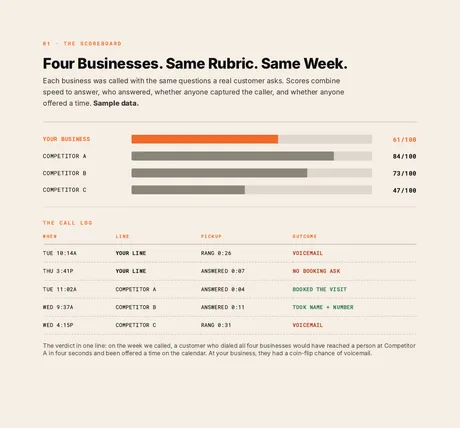 See a Sample Report (PDF)Six pages. Five recorded calls, one timed form fill, scored by AI against published standards.What it findsCalls ringing out to voicemailAnswered calls that never ask for the jobForm fills that wait hours for a humanThe competitor winning the first call
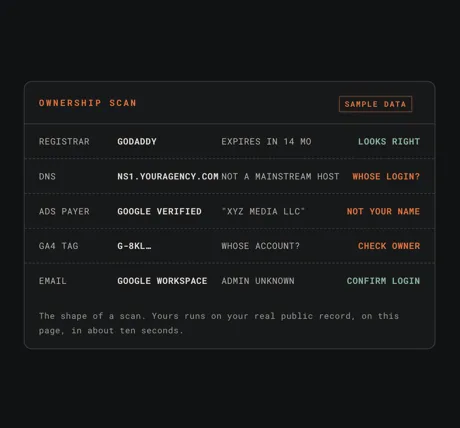 See What a Scan ReturnsPublic records read from the outside, in about ten seconds, with nothing to install.What it readsThe registrar, and when the domain expiresDNS, and whose nameservers those areThe business name paying for the adsThe GA4 tag and the email host
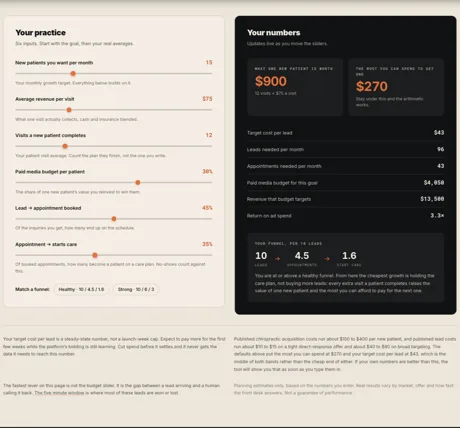 Run the NumbersSix sliders, figures that move as you drag them, and nothing you type leaves the page.What it works outWhat one new patient is worthThe most you can spend to win oneLeads and appointments you need a monthThe paid budget that hits the goal
 Read the LatestWritten off real Long Island accounts, the things we get wrong included.What it coversPaid media and budget decisionsSEO and the local map packLead follow-up and response timeRunning a Long Island business
See a Sample Report (PDF)Six pages. Five recorded calls, one timed form fill, scored by AI against published standards.What it findsCalls ringing out to voicemailAnswered calls that never ask for the jobForm fills that wait hours for a humanThe competitor winning the first call
See What a Scan ReturnsPublic records read from the outside, in about ten seconds, with nothing to install.What it readsThe registrar, and when the domain expiresDNS, and whose nameservers those areThe business name paying for the adsThe GA4 tag and the email host
Run the NumbersSix sliders, figures that move as you drag them, and nothing you type leaves the page.What it works outWhat one new patient is worthThe most you can spend to win oneLeads and appointments you need a monthThe paid budget that hits the goal
Read the LatestWritten off real Long Island accounts, the things we get wrong included.What it coversPaid media and budget decisionsSEO and the local map packLead follow-up and response timeRunning a Long Island business
Digital Platforms · Capability
Websites, landing pages, tracking, CRM connections and dashboards. Not web design as a deliverable: the layer every click, call and booked job runs through.
What are digital platforms at Efferent?
Everything between the click and the customer record. The website and the landing pages a campaign deserves. Call tracking and form attribution that keep the click id alive. The CRM connection that records which lead became a job. And the reporting layer that counts customers instead of clicks. Lead generation fills this layer; AI and automation work inside it; strategy reads its numbers. When it leaks, every channel upstream reports worse than it is performing, which is why we treat it as infrastructure rather than as a design project.

Why it is a layer, not a website
The most common one we find is a form that works perfectly and quietly drops the click id, so every paid lead reports as direct traffic and the ad platform never learns which campaign produced it. It throws no error and looks correct in every screenshot.
The second most common is a CRM that knows which lead became a customer and never tells the ad platform. Both leaks are in this layer, and neither shows up in a web design proposal.
How we build it
Five properties, in dependency order. Each one is testable before the next gets built.
01 / 05
01
Most of your traffic is a person in a driveway comparing three companies. The site has one job in that moment and two seconds to do it.
02
Call, book or send. Landing pages are built for the campaign, not borrowed from the website.
A page asking for four things is asking for none of them
03
Call tracking, form attribution, hidden fields for the click id and every UTM. Wired and tested before a dollar of media lands on it.
04
The handoff tested end to end, so a lead arrives with its source attached and a booked job can be traced back to the click that started it.
This connection is what makes offline conversions possible at all
05
A reporting view that counts qualified leads, appointments and jobs, open at any hour, built from your own records rather than from a slide.
What this layer carries
Every link below the ad platforms lives in this layer. The highlighted rows are the two links most often missing when an account comes to us.
The chain a dollar travels
DIAGRAMYour ROI tracker, in the client portal
Sample dataPORTALDid marketing pay for itself?
Total invested
$119,100
Google + Meta spend
Revenue attributed
$485,900
43 projects sold × avg value
Net ROI
+$366,800
In the black
Return per $1
$4.08
breakeven = $1.00
Customers won · year to date
43
Projects sold
▲ 19% vs prior periodScope
Keep going
The specialist page: how we design and build the sites themselves.
Decides what this layer should be measuring.
Fills this layer with demand worth converting.
Answers, follows up and reports inside it.
FAQ
Straight answers. If something is not here, ask us on the audit call.
No. The site is one component. The layer also covers landing pages, call and form tracking, the CRM connection and the reporting that counts customers. A site built without those is a brochure with a form on it.
Yes. The site is built in your name on your hosting, the tracking and CRM are in your accounts, and you keep all of it if we part ways.
Often yes. If the foundation is sound, fixing speed, structure and tracking costs far less than a rebuild, and we will tell you which situation you are in.
A campaign page has one job and a website has twenty. Sending paid traffic to a general service page is the most common conversion leak we find.
It is the CRM telling the ad platform which leads became customers, so bidding learns from won work instead of from raw volume. Without it the platform optimizes toward whatever converts cheapest, which is rarely your best customer.
Your own records: the call log, the form fills, the CRM pipeline. Nothing in the reporting view is an estimate we typed in.

Let’s talk
Tell us about your business. We’ll show you where the growth is, within 48 hours.