Paid Ad Management
Google and Meta ads built to generate calls and booked jobs, not impressions.
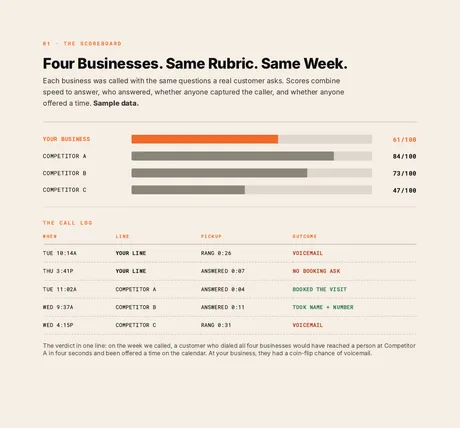 See a Sample Report (PDF)Six pages. Five recorded calls, one timed form fill, scored by AI against published standards.What it findsCalls ringing out to voicemailAnswered calls that never ask for the jobForm fills that wait hours for a humanThe competitor winning the first call
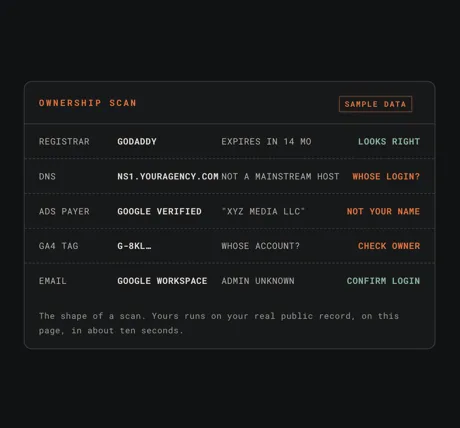 See What a Scan ReturnsPublic records read from the outside, in about ten seconds, with nothing to install.What it readsThe registrar, and when the domain expiresDNS, and whose nameservers those areThe business name paying for the adsThe GA4 tag and the email host
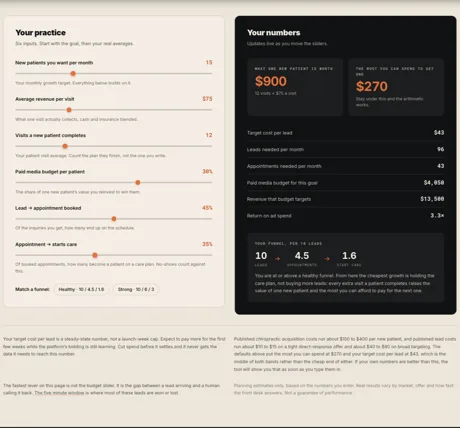 Run the NumbersSix sliders, figures that move as you drag them, and nothing you type leaves the page.What it works outWhat one new patient is worthThe most you can spend to win oneLeads and appointments you need a monthThe paid budget that hits the goal
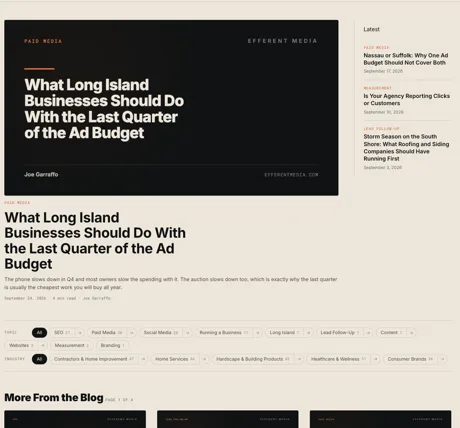 Read the LatestWritten off real Long Island accounts, the things we get wrong included.What it coversPaid media and budget decisionsSEO and the local map packLead follow-up and response timeRunning a Long Island business
See a Sample Report (PDF)Six pages. Five recorded calls, one timed form fill, scored by AI against published standards.What it findsCalls ringing out to voicemailAnswered calls that never ask for the jobForm fills that wait hours for a humanThe competitor winning the first call
See What a Scan ReturnsPublic records read from the outside, in about ten seconds, with nothing to install.What it readsThe registrar, and when the domain expiresDNS, and whose nameservers those areThe business name paying for the adsThe GA4 tag and the email host
Run the NumbersSix sliders, figures that move as you drag them, and nothing you type leaves the page.What it works outWhat one new patient is worthThe most you can spend to win oneLeads and appointments you need a monthThe paid budget that hits the goal
Read the LatestWritten off real Long Island accounts, the things we get wrong included.What it coversPaid media and budget decisionsSEO and the local map packLead follow-up and response timeRunning a Long Island business
Lead Generation · Capability
Paid search, SEO, local search, paid social, Local Service Ads, streaming and content are not seven products. They are seven ways into the same pipeline, and they are run and measured together.
What does lead generation mean at Efferent?
It means running every acquisition channel as one system with one scoreboard. Paid search and Local Service Ads capture the demand that already exists. SEO and local search earn the same demand at a lower long-run cost. Paid social, programmatic and content create demand once the capture side is saturated. One team runs all of it, one definition of a qualified lead applies everywhere, and budget moves monthly to whichever channel produced booked work, read from the CRM rather than from each platform’s own scorecard.

Why one system
Buy SEO from one vendor, ads from another and social from a third and you get three reports, three definitions of a lead, and three teams bidding for the same budget with no one accountable for the total. Every report looks fine and nobody can say which channel produced the job you actually booked.
Run them as one system and the question changes from which vendor is right to where the next dollar goes. That is a question that has an answer.
How the channels fit
Not every account runs every channel. Almost every account builds in this order.
01 / 05
01
Call attribution, form attribution and the CRM handoff. Every channel below reports through this, so it goes first on every engagement.
Handled by the Digital Platforms layer, which is the point of having one
02
Paid search and Local Service Ads. People actively searching for what you do, in the towns you serve. Fastest to prove, easiest to measure.
03
SEO and local search take longer to build and cost far less to hold, and they make the paid position optional rather than mandatory.
Rented and earned, run together on purpose
04
Paid social, programmatic and content grow the market you are fishing in. Bought before capture is working, they are expensive theater.
05
Offline conversions from the CRM tell the ad platforms which leads became customers, so bidding learns from won work rather than from volume.
This is where cost per booked job usually falls
Where a lead can come from
A local results page is stacked, and each layer is a different channel in this system. Most businesses compete for one of them.
How a local results page is stacked
DIAGRAMWhere a lead is lost between the click and the job
Sample dataDIAGRAMScope
Under this capability
Google and Meta ads built to generate calls and booked jobs, not impressions.
Show up when Long Island customers search for what you do.
Own the map pack in the towns you actually serve.
Meta and Instagram built around demand, not vanity reach.
The pages, posts and video that earn the search and the trust.
Google Guaranteed placement above everything else in the results.
Connected TV and audio that reach Long Island households at scale.
The other three layers
Decides what needs fixing first. A senior strategist on the whole business, not one campaign.
Turns demand into measurable action. Sites, landing pages, tracking, CRM connections and dashboards.
Keeps opportunities moving. Voice agents, lead response, follow-up, reporting and custom systems.
FAQ
Straight answers. If something is not here, ask us on the audit call.
Usually paid search or Local Service Ads, because they capture demand that already exists and prove the economics fastest. SEO and local search get built underneath them. The audit tells you which order fits your market, and it is free.
No, and most accounts never run all seven. Three or four, in the right order, beats seven bought at once. We will tell you which ones are not worth your money.
On qualified leads and booked jobs, read from the CRM. A qualified call is inbound, answered, over sixty seconds. Platform-reported conversions are an input, not the scoreboard.
Once search is saturated. If people are already searching for what you do and you are not capturing all of it, social is the more expensive way to reach the same customer.
One definition of a lead, one report, and a budget that moves between channels. Separate vendors each defend their own line; a system moves money to what produced booked work.
You do. Everything is built in your name on your billing, and you keep it all if we ever part ways.

Let’s talk
Tell us about your business. We’ll show you where the growth is, within 48 hours.