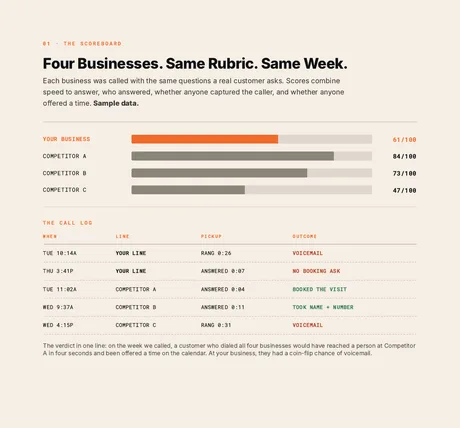
 See a Sample Report (PDF)
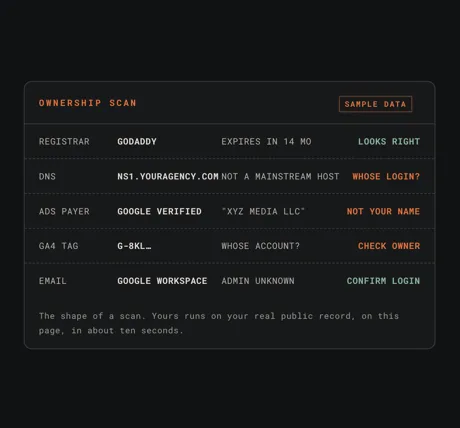 See What a Scan Returns
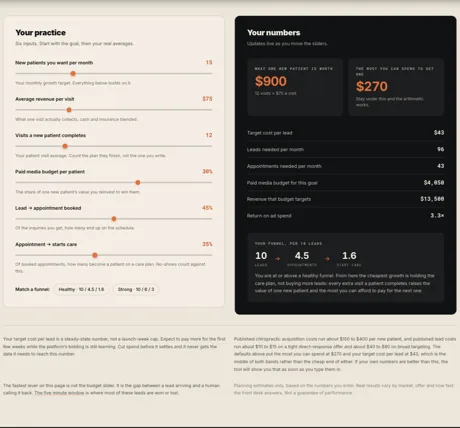 Run the Numbers
 Read the Latest
If one campaign covers both counties, you are almost certainly funding the weaker half with the stronger half's results, and the report cannot show you which is which.
That is the whole argument, and it holds for nearly every Long Island business we look at. The fix is not complicated. It is a decision that has to be made deliberately, because nothing in the ad platforms will prompt you to make it.
They Are Two Markets
Nassau and Suffolk share a landmass and very little else that matters to a campaign.
The competitive sets differ. The companies bidding against you in Garden City are not the companies bidding against you in Medford. Different competitors bid differently, so the same keyword costs a different amount to win depending on which half of the Island the search came from.
The customers behave differently. Household density, property type, average job size, how far somebody expects a contractor to travel, how much comparison shopping happens before a call. None of these are uniform across the line, and several of them are not uniform inside each county either.
The geography does different things to your operation. A Nassau customer is usually a shorter drive from a Nassau shop than a Suffolk customer is from a Suffolk shop, simply because Suffolk is much larger. That is a real cost difference on every job, and it belongs in the bid.
Run them together and all of that averages into one number that describes neither.
What the Averaging Hides
Here is the shape of the problem, using deliberately round illustrative figures rather than a client's data.
Suppose a single campaign spends eight thousand dollars across both counties and produces a cost per qualified lead you are happy with. Underneath that average, one county could be producing leads at well under the target while the other produces them at well over it. The blended number sits comfortably in the middle and nobody investigates, because nothing looks wrong.
Every additional dollar added to that campaign gets distributed by the platform according to its own optimization, not according to which county you would rather grow in. You are funding both halves and steering neither.
Split them and the same eight thousand becomes two visible decisions: how much to spend defending the strong county, and whether the weak one deserves investment, repair or exit. Those are three completely different responses and you cannot choose between them without the split.
How to Split It
The mechanics are simple and the discipline is in keeping them identical.
- Duplicate the campaign. Same keywords, same ad copy, same landing pages, same bidding strategy. The only difference should be the location targeting and the budget.
- Set location targeting to one county each. By town list where you can, rather than by county alone, because a service area is a list of places you go rather than an administrative boundary. That is its own piece.
- Give each a budget you chose, rather than splitting the old one down the middle by default. Start proportional to where your work already comes from.
- Wait a full cycle before judging. A change to budget or structure resets some of what the bidding has learned, and the first two weeks after any structural change are not a fair read on anything.
- Then compare the two on cost per qualified lead, not cost per click. Click costs will differ and that is expected. Whether the lead is worth what it cost is the question.
What to Do With the Answer
Usually one of three things, and the point of splitting is that you can now tell which.
The weaker county is more expensive but still profitable. Keep it, fund it at a level that matches its return, and stop expecting it to match the other one.
The weaker county is losing money because the offer does not land there. This is more common than it sounds and it is a copy and landing page problem rather than a budget problem. Same service, different framing, sometimes different service emphasis entirely.
The weaker county is losing money because you cannot serve it well. Drive times, crew availability, a shop on the wrong end. That is an operations answer and the right marketing response is to stop paying to generate work you will decline.
All three are reasonable outcomes. None of them is reachable while the two counties are averaged into one line.
The Same Logic Goes Further Down
Once the split is running and you are comfortable with it, the same reasoning applies inside each county. Suffolk in particular is not one market, and the difference between its western towns and the East End is larger than the difference between the counties. That is a later refinement rather than a starting point, but it is the same move: stop averaging markets that do not behave alike.
If you want to know what your current campaign is averaging, that breakdown is part of the free marketing audit. It is usually the first slide that changes somebody's plan for the quarter.
Frequently Asked Questions
- Does splitting the budget mean doubling the work?
- No. It means one campaign becomes two, sharing the same keywords, copy and landing pages. The setup is an afternoon. What changes afterward is that you can see and control each half separately.
- What if we only serve part of one county?
- Then split by the towns you serve rather than by the county line. The principle is that a budget should cover one market, and a market is defined by how customers and competitors actually behave rather than by an administrative boundary.
- Which county is cheaper to advertise in?
- It varies by trade and by month, which is exactly the argument for measuring yours rather than taking a general answer. What is consistent is that the two differ enough to matter.