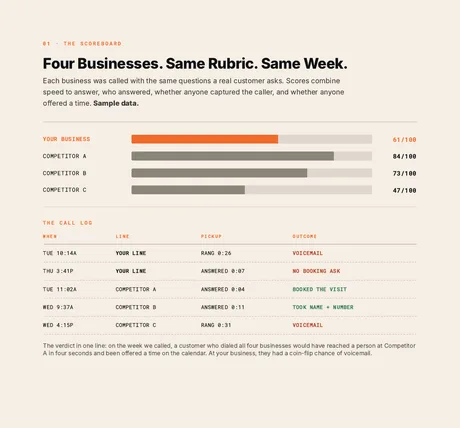
 See a Sample Report (PDF)
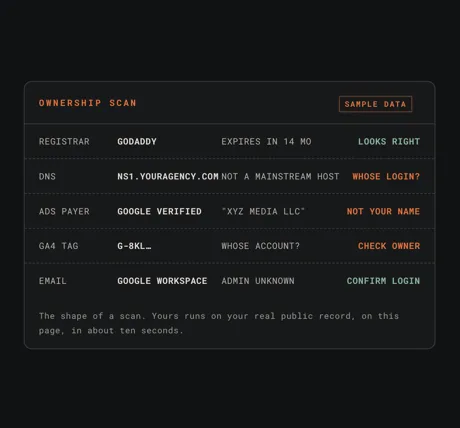 See What a Scan Returns
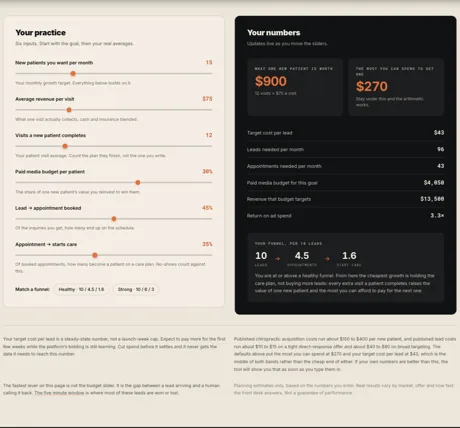 Run the Numbers
 Read the Latest
Target the towns you actually serve, by name, rather than a radius in miles. On Long Island a radius is close to the worst available way to describe a service area, and the cost of using one is paid quietly, in clicks from places you cannot reach.
The reason is geography. Long Island is roughly a hundred and twenty miles long and twenty across at its widest, bounded by water on three sides, with parkland, bays and inlets cut into it. Draw a fifteen mile circle around a shop in Babylon and a substantial share of that circle is the Great South Bay and the Atlantic. Draw one around a shop in Port Washington and you have bought a large part of the Sound.
A radius assumes you can travel in every direction equally. Here you cannot travel in most directions at all.
What a Radius Actually Buys You
Three separate problems, and they compound.
Water and parkland. The circle includes area with no households in it. That portion of the targeting does nothing, which is harmless, but it makes the radius look larger than the reachable market it describes, so the number gets set too high to compensate.
Towns on the wrong side of a barrier. Fifteen miles as the crow flies can be a forty minute drive around a bay, or across a parkway at the wrong hour. The circle treats those as identical to a town fifteen minutes up Sunrise Highway. Your dispatcher does not.
The counties do not behave alike. A radius that straddles the Nassau and Suffolk line buys two markets with different costs per click, different competitors and different customer expectations, under one bid. We wrote that one up separately in the piece on splitting the budget by county.
The result is a campaign that looks like it is working, because the clicks are real and the cost per click is fine, while a share of the spend goes to people you will decline to serve when they call.
Build the List From Last Year's Jobs
The right starting point is not a map. It is your own job history.
- Export last year's completed jobs with their addresses. Whatever system holds them, the invoices will do.
- Count jobs by town. Not by zip, by town, because that is how people here describe where they live and how the search data is organized.
- Sort by volume. The shape of this list is usually a surprise. Most companies find their real work is concentrated in fewer towns than they describe to customers, and that two or three towns they assume are core produced almost nothing.
- Mark the towns you want and do not have. These are a separate group and they get a separate budget, because buying into a new town is a different job from defending one you already own.
That produces three tiers: towns you own, towns you serve, towns you want. Each deserves a different bid and a different page, and none of them is well described by a circle.
The Same List Should Drive Both Channels
The common failure is defining a service area once for paid and again, differently, for SEO. Then the ads run in twelve towns and the site has pages for six, three of which are towns the ads exclude.
Define it once, in writing, and let it drive:
- Paid targeting. Location targets by town or zip, with bid adjustments by tier rather than one flat bid across the whole area.
- Town pages. One page per town you genuinely serve, with content that could only be about that town. A template with the name swapped is detectable and it is everywhere. That is its own subject and it gets how we build town pages.
- Your Google Business Profile service area. Which should match, and on most profiles we look at, does not.
- Negative locations. The towns you have decided not to serve should be excluded explicitly, not left to a radius that never knew about them.
Presence Versus Proximity
One caveat worth stating, because it gets misread. Excluding a town from paid targeting does not remove you from organic results there, and it should not. Somebody in a town you do not prioritize may still find you, call, and be worth serving. The point of the list is to decide where you spend money to be found, not to build a wall.
The distinction matters most for emergency work. A homeowner with water coming through a ceiling will call whoever appears, and the drive time question gets answered on the phone rather than in the targeting. For emergency campaigns, a wider area with a tighter ad is usually right. For planned work, the narrower list wins.
Check Yours in Ten Minutes
Open the location settings on your main search campaign and read what is actually there. If it says a radius, write down the number. Then open a map, draw that circle, and name three towns inside it you would refuse to drive to and two outside it you drive to every week.
If you can do that, and most owners here can do it immediately, the radius is costing you money right now. Replacing it with a list is an afternoon of work and it does not require a new campaign.
Frequently Asked Questions
- Is radius targeting ever the right choice?
- In a dense grid city, often. On Long Island, rarely. The geography is long, narrow and interrupted by water, so a circle drawn around a shop includes a great deal of area no truck can reach and excludes towns fifteen minutes up the same road.
- How many towns should a service area list contain?
- However many you would actually drive to, which is usually fewer than an owner first says. Start from last year's job addresses rather than from ambition, then add the towns you want next.
- Does this affect SEO or only paid ads?
- Both, and in the same direction. Paid targeting decides who sees the ad. Local SEO and town pages decide who finds you organically. A service area defined once should drive both rather than being redefined per channel.