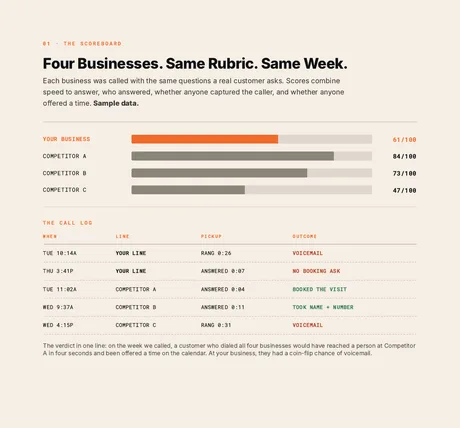
 See a Sample Report (PDF)
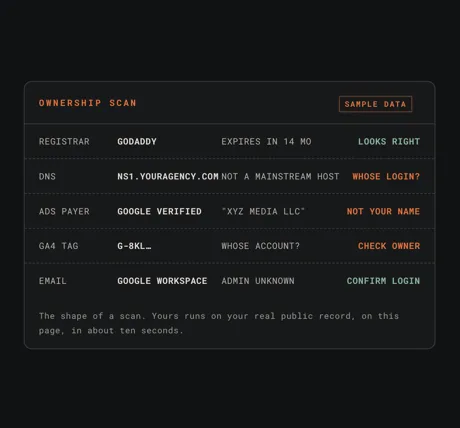 See What a Scan Returns
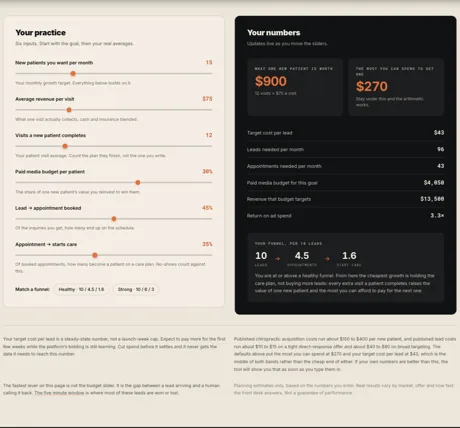 Run the Numbers
 Read the Latest
Emergency demand does not wait for you to be ready. It arrives inside a few hours of the weather, peaks in about two days, and is over before most companies have finished deciding whether to respond.
So the work is not what you do during the storm. It is what is already running when it starts.
Four Things, Built Before You Need Them
One: a paused storm campaign that someone can switch on from a phone. Ad copy written, landing page live, budget set, targeting done, status paused. Building this in advance is the whole point. A campaign created during the event goes into a learning period exactly when you need it to perform, and the person creating it is the person who should be dispatching crews.
Two: a page that answers the emergency question. Not your roofing services page. A page for somebody standing in a hallway with a bucket. What to do right now, whether it is safe to wait, what an inspection costs, how fast you can get there, and one obvious way to reach you that is not a form. The form is for the estimate. The emergency is a phone call.
Three: a phone plan for the surge. This is the one most companies skip and it is the one that decides the outcome. During a real storm the call volume is several times normal and the office is short handed. Decide in advance who answers, what happens when all lines are busy, and what the voicemail says. A voicemail that says "leave a message" loses the caller. One that says "we are getting to everyone in order, leave your address and a number and we will call within the hour" keeps most of them, provided that is true.
Four: a way to capture the ones you cannot reach today. You will be over capacity. The homeowner you cannot see until Thursday is still a customer if somebody tells them Thursday. The lead that gets no answer at all calls the next company in the results, and they will not call you back.
The Difference Between Being First and Being Loud
Storm response has a reputation problem in this market, earned by out of state crews who follow weather and leave. Every local contractor is competing against the memory of those crews, and the fastest way to be mistaken for one is to sound like one.
Which means the ad copy for a storm campaign should be doing the opposite of what urgency copy usually does. Name the town. Say how long you have been here. Say you are licensed and insured in New York, because a homeowner who got burned once now checks. Offer an inspection rather than a price.
The company that reads as local and calm wins against the company that reads as loud, in this category specifically, and the gap is widest in exactly the week when everybody else is shouting.
After the Storm Is Half the Work
The storm produces two groups, and most companies serve only the first.
The first group is the emergency: tarps, patches, water. You will handle those because they are on fire.
The second group is larger and quieter. It is everybody whose roof is fine but who just spent a night listening to it and is now, for the first time in six years, thinking about replacing it. They are not calling this week. They will call in the spring, and they will call the name they saw in October.
That second group is the actual return on a storm campaign, and it only exists if you stayed visible after the emergency ended. Keep the campaign running at a lower budget for a few weeks after, point it at the planning question rather than the emergency one, and make sure every emergency lead you could not serve gets a follow-up rather than a closed ticket.
The Readiness Check
Before the first real weather, run through this once. It takes under an hour and all of it is verification rather than building.
- The storm campaign exists, is paused, and somebody who is not you knows how to enable it.
- The emergency page loads in under three seconds on a phone on a weak signal, which is the actual condition it will be read in.
- The phone number on that page is the one somebody will answer, not the main office line.
- Your Google Business Profile hours are right, and there is a plan for updating them if you extend.
- The voicemail script has been rewritten and recorded.
- Somebody owns the follow-up list for people you could not reach.
None of that is marketing work in the usual sense. All of it decides how much the marketing produces.
If you want a second pair of eyes on the setup before the season, that is part of the free marketing audit, and October is the right month to ask.
Frequently Asked Questions
- How fast does storm demand actually appear?
- Within hours of the weather, not days. The searches begin while the wind is still up and the heaviest volume lands in the first forty eight hours after it stops. A campaign switched on the following Monday has missed most of it.
- Should we run storm campaigns year round?
- Keep them built year round and paused, with the budget at zero. Building a campaign takes time you will not have; enabling one takes a minute. What you cannot do is create the landing page, the tracking and the ad copy while the phone is ringing.
- What about price gouging concerns?
- Do not raise prices for emergency work, and do not let the ad copy imply urgency pricing. It is bad practice, it generates the reviews you will spend two years answering, and on Long Island word travels faster than any campaign.