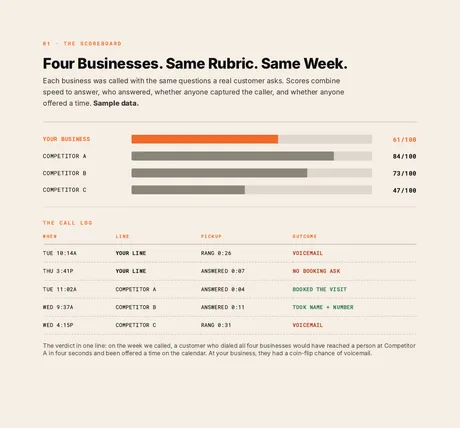
 See a Sample Report (PDF)
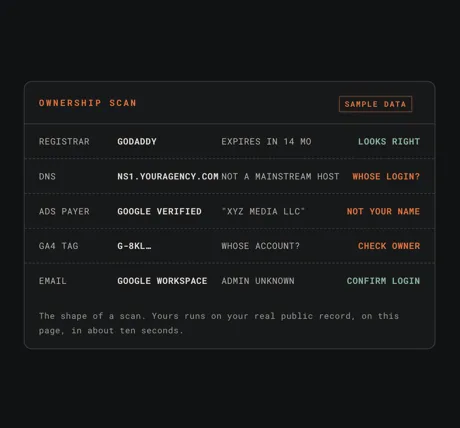 See What a Scan Returns
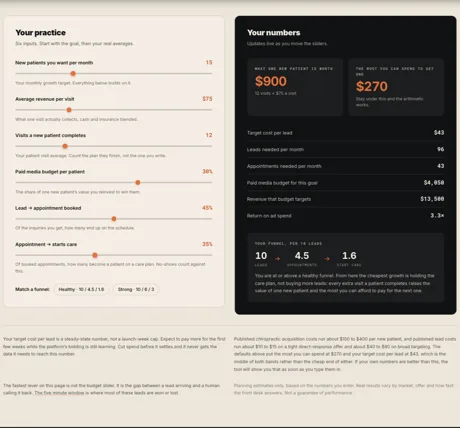 Run the Numbers
 Read the Latest
When somebody asks an assistant which company to call, the response names two or three businesses. Not ten. That is the whole change, and it makes the difference between being cited and being fourth much larger than the difference between ranking third and ranking fourth ever was.
The work that gets you into that set is not new. It is the same set of inputs that already decided local search, which is a disappointing answer and the correct one. What is new is that the payoff is more concentrated, so doing it properly matters more than it did.
What These Systems Are Actually Doing
Simplified, and close enough to be useful: they retrieve from sources they already have reason to trust, then write a response from what those sources say.
Two consequences follow directly.
Being retrievable matters more than being ranked. A page that clearly and plainly answers the question is a better candidate than a page optimized around a keyword, because the system is looking for an answer to lift, not a document to list.
Consistency across sources matters more than it used to. When several places agree on what your business is, where it works and what it does, that agreement is itself a signal. When your profile, your website and three directories disagree about your service area or your phone number, there is no confident answer to assemble.
Five Things That Actually Move It
1. Answer real questions, plainly, in your own pages. The questions customers ask on the phone. What does this cost. How long does it take. Do I need a permit. Is this covered. Answer in the first paragraph, then expand. A page that buries its answer under four hundred words of throat-clearing is a poor retrieval candidate and a worse read.
2. Be unambiguous about where you work and what you do. Name the towns. Name the services separately rather than in one list. A page that says "serving Long Island" is less useful to a system trying to answer a question about Massapequa than one that says Massapequa. This is the service area discipline applied to content rather than targeting.
3. Keep your business facts identical everywhere. Name, address, phone, hours, service area. Across the profile, the site, and every directory that carries you. This is unglamorous, it has been the advice for a decade, and it is doing more work now than it was.
4. Earn mentions on sources that already have standing. Local press, trade associations, supplier and manufacturer directories, chambers. A mention on a site that is already trusted is worth more than a page of your own saying the same thing, because it is independent.
5. Say who wrote it and why they would know. A named author with a real role and real experience is a credibility signal to a system deciding whether to lean on a page. It is also just better for the human reading it.
What Not to Bother With
Stuffing an FAQ with questions nobody asks to hold keywords. It is transparent and it makes the page worse for the person reading it.
Publishing volume. More pages stopped being an advantage years ago. Fewer, better pages that answer real questions beat a content calendar every time.
Any product promising to place you in AI answers. Nobody has that ability. What they can sell you is the same content and consistency work under a newer name, at a markup.
How to Check, Without Guessing
Pick five questions a customer would genuinely type. Not your keywords, their questions. Ask them in the assistants your customers actually use. Write down who gets named, and whether you appear at all.
Do it monthly, same questions, same place, and keep the list. That is a manual check and it is currently the only direct evidence available. A stable record of who gets cited over six months tells you more than any tool claiming to score you.
The Honest Position
For a local service business, this is an important shift that requires almost no new work and a fair amount of doing the old work properly. The businesses that will be cited are, overwhelmingly, the ones already doing the boring things well: complete profiles, consistent facts, pages that answer questions, reviews that are real and recent.
If that sounds like it undersells the moment, that is deliberate. The wider version of the same argument is here. The engine changed. What feeds it did not.
Frequently Asked Questions
- Is there a separate thing I have to buy for this?
- No, and be careful with anyone selling one. The inputs are the same ones that already mattered for local search, which is unsatisfying and true. What changed is the payoff shape, not the work.
- How do I know if I am being cited?
- Ask the question a customer would, in the tools your customers use, and write down who gets named. Do it monthly for the same handful of questions. It is a manual check and it is the only direct evidence available.
- Does this replace ranking in search results?
- It sits alongside it. For a query with intent to hire somebody locally, the result still routes people to businesses, because the answer to "who should fix this" is a business rather than a paragraph. The map pack has not gone anywhere.