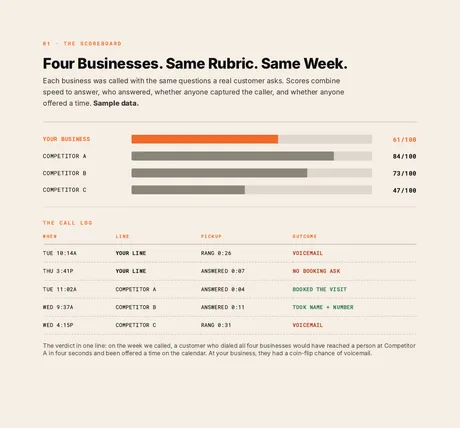
 See a Sample Report (PDF)
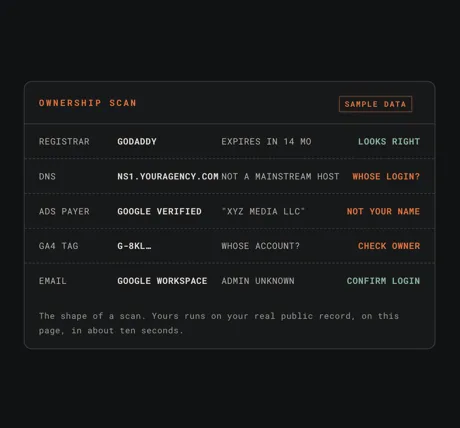 See What a Scan Returns
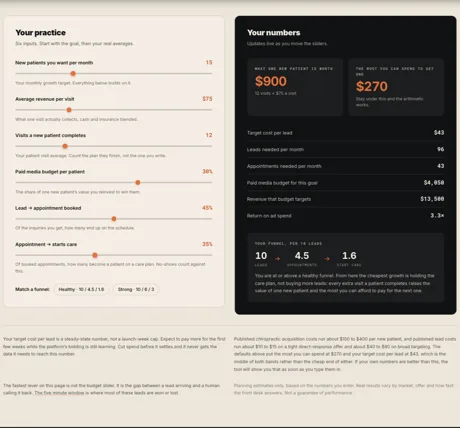 Run the Numbers
 Read the Latest
Every item here takes under an hour, none of them can be done in your busy season, and all of them are invisible while they are broken. That combination is why tracking rots: nothing ever forces the issue until a decision gets made on a number that was wrong.
Work through them in this order. The first three are the ones that change what your budget does.
1. Read What Each Conversion Action Counts
Open the conversion actions, one at a time, and answer two questions: what event fires this, and is it primary.
What turns up, routinely:
- An action counting a page view rather than a form submission, so every visitor to the thank-you page counts, including refreshes and direct hits.
- Two actions counting the same thing, added at different times by different people, so every lead is recorded twice and the cost per lead looks half what it is.
- A phone action firing on a tap, not a connected call.
- An action that stopped firing months ago after a site change, and nobody noticed because the number only drifted.
Automated bidding does exactly what these tell it. An action counting the wrong event does not produce an error. It produces a confident campaign optimizing toward the wrong thing.
2. Separate Primary From Secondary
Primary conversions steer the bidding. Everything else is reporting.
The common failure is promoting soft actions to primary because they produce encouraging numbers: newsletter signups, PDF downloads, clicks to a phone number. The system then buys more of the traffic that does those things, which is not the traffic that books work.
Primary should be the smallest set that genuinely represents a sales conversation starting. Usually that is a completed form and a connected call over a real duration. Everything else goes secondary, where you can still see it.
3. Verify the Count Against Reality
This is the check nobody runs and the only one that cannot be fooled.
Take one week. Count by hand how many real inquiries you received, from your own inbox and phone log. Compare to what the platform reports. If the numbers are close, your tracking is honest. If the platform is high, you are counting junk. If it is low, you have a coverage gap and are underspending on something that works.
A low count is the dangerous direction, because it reads as bad news about a channel and gets acted on. Nothing on the screen distinguishes a broken tracker from a channel that produced nothing.
4. Follow the Lead From Submit to Human
Fill in your own form. Call your own number. Do both outside business hours, from a phone nobody at the office recognizes.
Then find out where each one actually landed, who was notified, and how long until a person made contact. On most accounts we inherit, at least one of those paths is broken, and no amount of tracking accuracy compensates for a lead arriving somewhere nobody looks. The five minute window is where this gets expensive.
5. Check the Tracked Numbers Actually Ring
Dynamic call tracking swaps the number a visitor sees. When it works, attribution improves. When it half works, you have a number on your site that rings nowhere, and it is completely silent.
Call every tracked number. Confirm each rings the right line, is answered, and appears in the call log afterward.
While you are there, check the number in your Google Business Profile matches what you expect. A mismatch between the profile number and the site number can confuse a local listing, and it is a two-minute fix.
6. Connect the Outcome Back
The four above are repairs. This one is the change.
Until a booked job flows back to the platform that produced the lead, bidding is optimizing toward inquiries rather than revenue, and it cannot tell the difference between a channel producing ten tire kickers and one producing two real jobs.
It takes a few weeks to build and it is the single most common thing missing on an account we take over, including accounts managed by somebody else for years. What a report looks like once it exists is a different document entirely.
The Reason It Is This Week
None of the six is difficult. All six require an uninterrupted hour and somebody willing to look at unglamorous plumbing, and neither exists in your busy season.
They also compound. Every decision made between now and the fix is made on the numbers you have. Fixing them in November means the spring is steered by something true.
Frequently Asked Questions
- How do I know if a conversion action is broken?
- Compare its count to something you can verify by hand. Take one week, count the real inquiries you actually received, and compare. If the platform says forty and you had twelve, something is counting the wrong event. The comparison takes twenty minutes and it is the only check that cannot be fooled.
- Should every form submission be a conversion?
- Every one should be recorded. Not every one should be primary. Primary conversions are what bidding optimizes toward, so a low-intent action promoted to primary teaches the system to buy more low-intent traffic, which it will do very efficiently.
- Is a click on a phone number a conversion?
- It is a signal, not a conversion. A tap is not a conversation. Count connected calls over a real duration if you can, and keep the tap as a secondary action so it informs without steering the bidding.